

Knowledge · Standards
How to Waterproof a Secant, Contiguous or Sheet Piled Basement Wall
Piled basement walls leak at their joints. How BS 8102:2022 treats secant, contiguous and steel sheet pile walls, when a concrete liner wall is needed, and how sheet pile clutches and the wall-to-slab junction are sealed.
By Johnny Etkind and Ben Hickman - PCA-registered Waterproofing Design Specialists, CLW · Last updated 17 November 2026 Prepared for the Institution of Structural Engineers webinar "Waterproofing new-build basements: systems, risks and watertight performance", 17 November 2026.
How is a piled basement wall waterproofed?
By dealing with its joints, because that is where water enters. Secant and contiguous concrete piles are normally faced with a reinforced concrete liner wall designed as Type B, or drained with a Type C cavity system, or both. Steel sheet piles can be Type B in their own right if the interlocks are sealed and the junctions with the slab are properly detailed.
This page sits under Type B waterproofing in our guide to waterproofing design for new-build basements.
In brief
- Piled walls leak at joints, so tighter crack widths in the piles themselves bring little benefit.
- Secant and contiguous walls normally need a Type B liner wall, a Type C system, or both.
- Sheet piles can be Type B: welded clutches where no seepage is acceptable, sealants for Grade 1a.
- Ask whether the liner wall can span floor to floor, so it does not puncture a membrane.
Full explanation
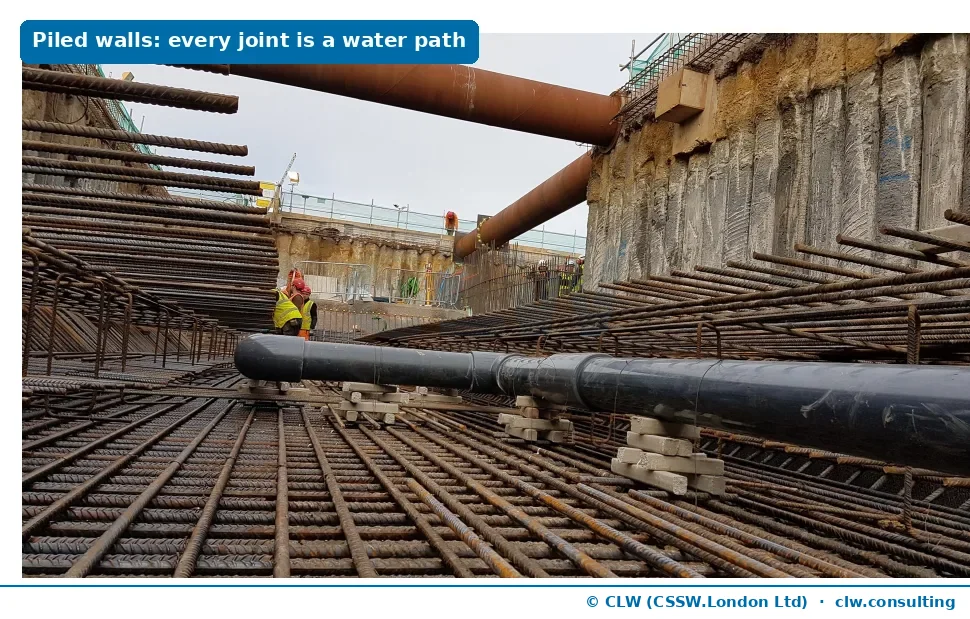
Secant and contiguous pile walls
Ingress through piled and diaphragm walls is governed by the joints. Designing the piles themselves to a higher Eurocode tightness class therefore brings little benefit. What should be specified is the water-resistance expected of the wall, including whether running water, dripping water and damp areas are acceptable.
In practice, trying to achieve Type B from secant or contiguous piles alone is much harder than building a waterproof concrete liner wall in front of them. The liner wall is then a conventional Type B element, designed for crack control like any other: see what waterproof concrete actually requires.
Two details to settle early:
- How the liner wall is restrained. Liner walls are often tied back to the piles. If there is a Type A membrane between the two, every tie punctures it, and every penetration is another place for a defect. Ask whether the liner wall can be designed to span floor to floor. The same applies to blockwork in front of a cavity drain system.
- The wall-to-slab joint. This is where the piled wall, the slab, any membrane and any waterstop meet. It should be reviewed in three dimensions.
A secant wall toed into clay can also act as a cut-off, which changes what the rest of the design has to do. On Salisbury Square that allowed a drainage layer beneath the lowest slab to relieve uplift, a structural decision that the waterproofing design then had to account for.
Steel sheet pile walls
Steel is impermeable. The water paths are limited to the interlocks between piles (the clutches) and the interfaces with other elements.
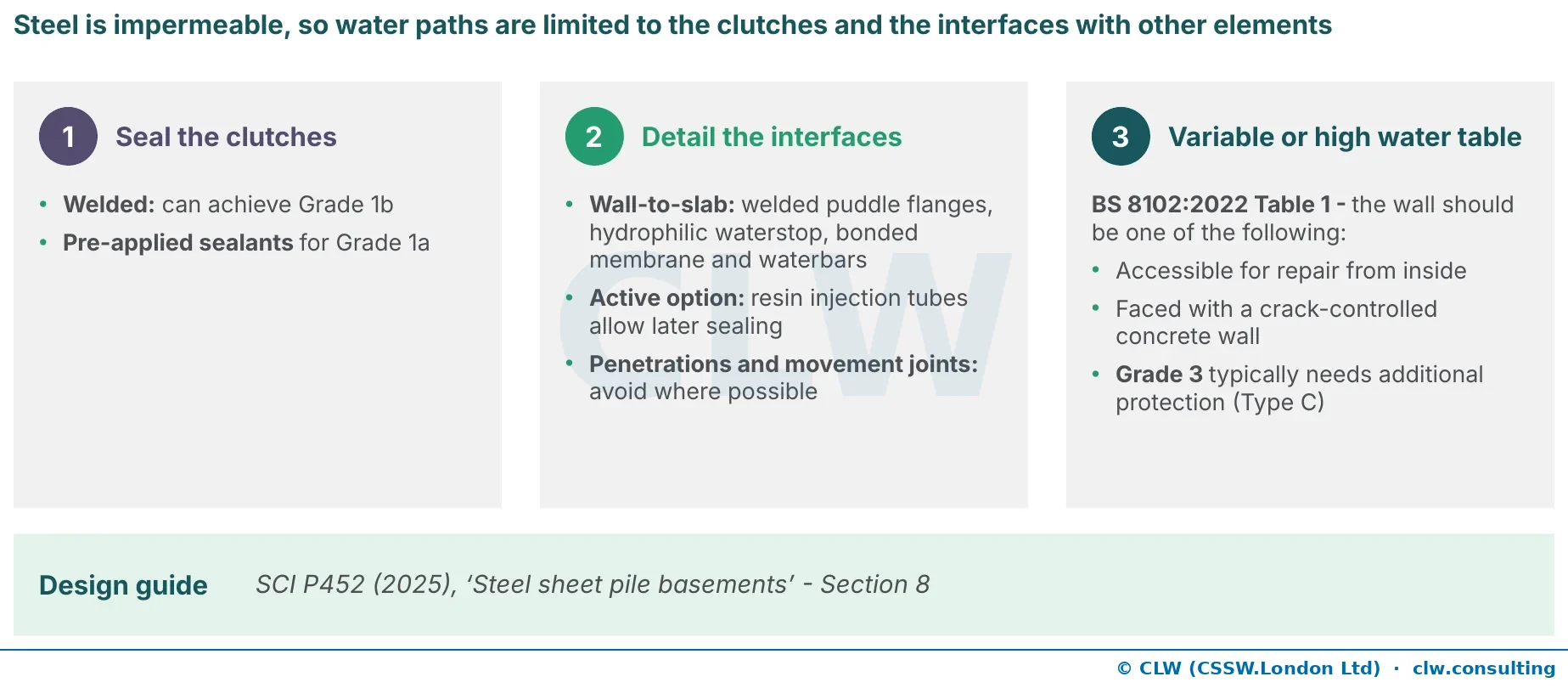
Clutches. Welded interlocks are the reliable route where no seepage is acceptable, which means Grade 1b and above. Pre-applied sealants in the clutches suit Grade 1a or lower-risk cases. Only hot-rolled piles should be used for a permanent basement wall, because cold-formed interlocks cannot be sealed reliably.
The wall-to-slab junction. This is the critical detail. It usually combines several compatible measures: a welded closure plate cut to the pile profile, hydrophilic waterstops, a bonded membrane and waterbars at the construction joints. Where the grade is high, resin injection tubes are fixed at the junction so that it can be sealed later if it leaks, and re-injected if it leaks again.
High or variable water table. The wall should be directly accessible from inside for repair, or combined with a fully bonded barrier, or faced with a crack-controlled concrete wall.
Grade 3. A sealed sheet pile wall will commonly be enough for Grades 1a and 1b. Grade 3 typically needs protection additional to the piles, usually a Type C system. See is combined protection required for Grade 3?
Penetrations and movement joints. Avoid them where possible.
What to ask at Stage 2
- What water-resistance is the piled wall itself expected to provide, and where is that written down?
- If there is an external membrane, what punctures it?
- Is the inside face of the wall going to be accessible once the building is finished?
- Who is detailing the wall-to-slab junction, and has the waterproofing designer seen it?
The piling design is usually fixed early, and it fixes a good deal of the waterproofing design with it. That is one of the reasons for appointing the waterproofing designer at RIBA Stage 2. For how we work on deep basements, see structural waterproofing design.
Frequently asked questions
How is a piled basement wall waterproofed?
By dealing with its joints, because that is where water enters. Secant and contiguous concrete piles are normally faced with a reinforced concrete liner wall designed as Type B, or drained with a Type C cavity system, or both. Steel sheet piles can be Type B in their own right if the interlocks are sealed and the junctions with the slab are properly detailed.
Can a secant pile wall be the waterproofing on its own?
Rarely for anything other than the lowest grades. Water ingress through piled walls is governed by the joints between piles, so designing the piles themselves to a tighter crack width brings little benefit. The water-resistance expected of the wall should be specified, including whether running or dripping water is acceptable, and further protection designed in front of it.
Do sheet pile clutches need to be welded for a watertight basement?
Where no seepage is acceptable - Grade 1b and above - industry guidance treats welded interlocks as the reliable route. Pre-applied sealants in the clutches suit Grade 1a, or lower-risk cases where a concrete liner wall provides the primary protection.
Can sheet piles alone achieve Grade 3?
Typically not. A sealed sheet pile wall will commonly suffice for Grades 1a and 1b; Grade 3 typically needs additional protection, usually a Type C cavity drain system inside. In a high or variable water table the wall should also be accessible for repair from inside, combined with a fully bonded barrier, or faced with a crack-controlled concrete wall.
Related guidance
- BS 8102 Performance Grades Are a Design Tool, Not a Review Standard
The four performance grades in BS 8102:2022 Table 2 specify what a basement must achieve. They are not a diagnostic tool for reviewing exist
- What Does BS 8102 Require for Waterproofing Design on Commercial Basements?
What BS 8102:2022 recommends for commercial basement waterproofing design, from the specialist appointment and risk assessment to grades, sy
- The BS 8102:2022 Waterproofing Guide
A single sweep through the most-missed clauses, Table 2 grade selection, Type A/B/C combinations, and the combined-protection misconception.
Working on a live scheme?
Put our AI agent to work. It'll reason through your specifics from BS 8102:2022 and land on a defensible recommendation.