

Knowledge · Standards
Type A Waterproofing to BS 8102:2022: What It Is, and Why It Is Not a DPM
Type A is barrier protection: a membrane, coating or render applied to the structure. Why it has to be fully bonded, why calling it a DPM invites the wrong product, and where it goes wrong on new-build basements.
By Ben Hickman - contributing member, BS 8102:2022 committee · Last updated 17 November 2026 Prepared for the Institution of Structural Engineers webinar "Waterproofing new-build basements: systems, risks and watertight performance", 17 November 2026.
What is Type A waterproofing?
Type A is barrier protection under BS 8102:2022: a separate waterproofing barrier applied to the structure, externally or internally, through which water should not pass. It includes pre-applied and post-applied sheet membranes, liquid-applied membranes, bentonite and polymer core liners, mastic asphalt, and cementitious coatings and renders. Tanking is the common name.
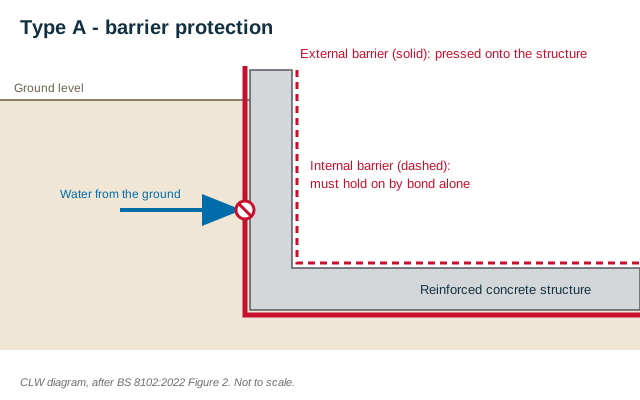
It is one of three forms of protection, alongside Type B and Type C. How they fit together on a new building is set out in waterproofing design for new-build basements.
In brief
- Type A is a barrier applied to the structure. Tanking is the common name.
- It is not a DPM: it resists water under pressure and should be fully bonded.
- Full bond means a leak needs a membrane defect and a concrete defect in the same place.
- It fails at discontinuities: pile caps, ties, laps, damage by following trades.
Full explanation
It is not a DPM
Drawings routinely label the basement membrane “DPM”. It is not one. A damp-proof membrane is typically a sheet of 1200-gauge polyethylene, loose-laid, intended to resist moisture rising from the ground. A Type A membrane has to resist water under pressure, is tested to different standards, and has to bond to the structure. NHBC says the same in terms: plain polyethylene sheet is not a waterproofing system.
The label matters because it travels. A drawing that says DPM gets a DPM priced, bought and laid.
The principle that makes Type A work: full bond
Every membrane will have a defect somewhere. What matters is what the water does when it reaches it.
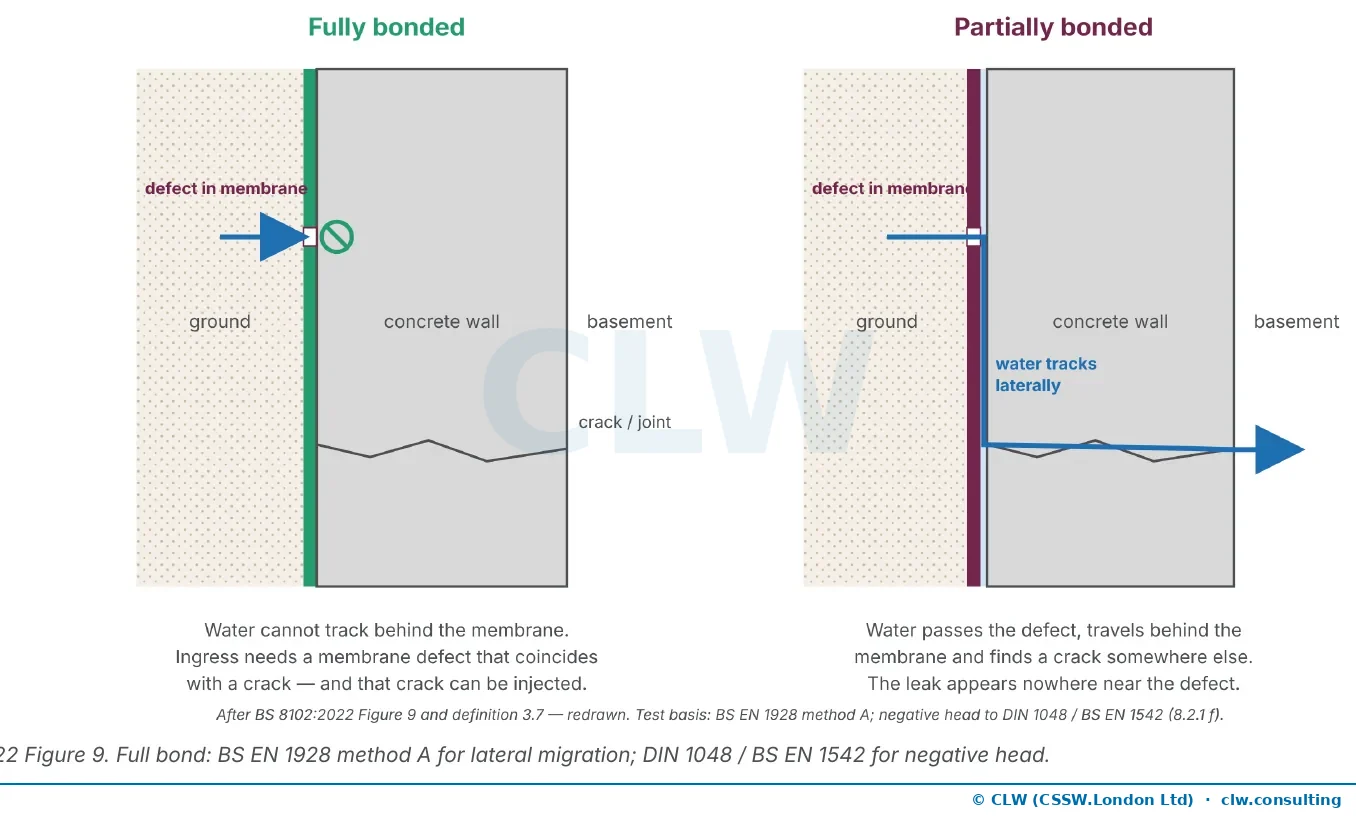
Where the membrane is fully bonded to the concrete, water reaching a defect meets concrete and has nowhere to go. Where it is loose or only partly bonded, water travels sideways behind the membrane until it finds a crack or a joint. The leak inside the building then bears no relation to the defect outside, and cannot be repaired by going to where the water appears.
Membranes achieve a bond in different ways: a mechanical key that the cement paste grips, a chemical bond with the fresh concrete, a fleece cast into it, or a swelling clay layer held in confinement between two surfaces. Whichever it is, a membrane counts as fully bonded only up to the water pressure in its test report. That figure should be checked against the design head.
External or internal
An external barrier is pressed against the structure by the water. An internal barrier is pushed off it, and has to resist that by bond alone.
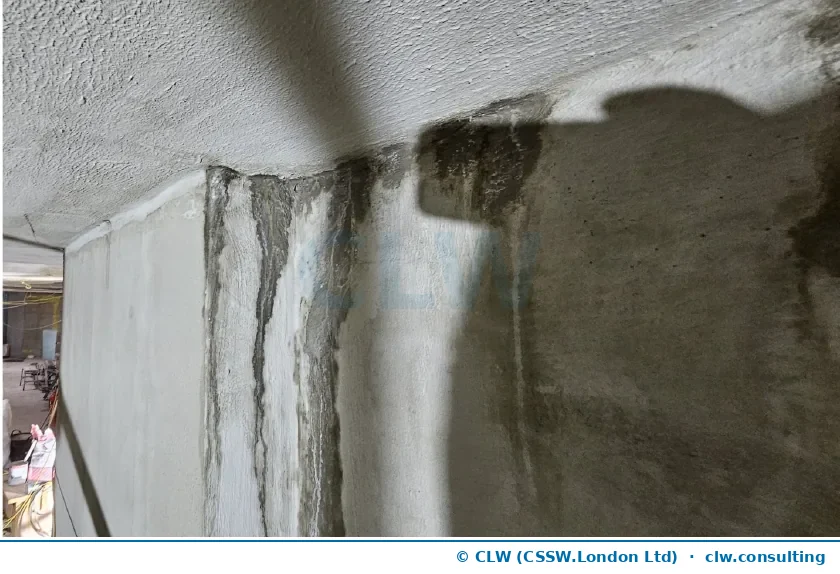
Internal Type A is nearly always a cementitious render or slurry. It is rigid, so settlement and shrinkage as storeys are added above can crack it; it should go on as late as practicable. Fixings through it, such as lift equipment bolted through a waterproofed lift shaft, are a risk. In a new-build design it would be unusual; it is more common in refurbishment.
Where Type A goes wrong on new build
Usually because it is asked to do too much.
- It doubles as the gas barrier. Waterproofing and ground gas protection are each specialist work. One membrane doing both needs a designer who understands both.
- Site conditions. A pre-applied membrane goes down in a damp, muddy excavation. Reinforcement is then fixed and cut on top of it, and tonnes of concrete are poured over it. It needs full, stable support and careful sealing of the laps.
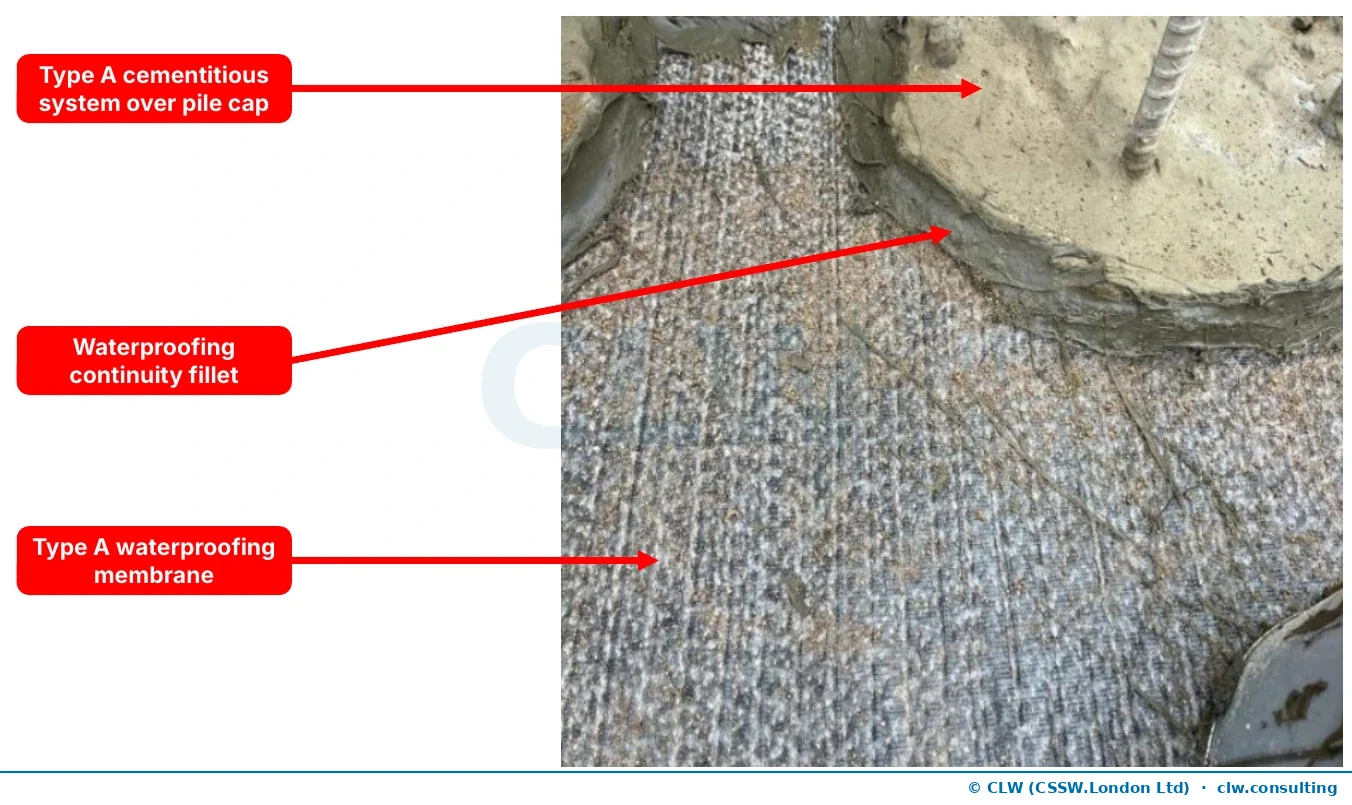
- Continuity. How does the membrane pass a pile cap, a capping beam, a prop or a keyed slab? The usual answer is a second system over the pile cap and a fillet joining the two. That has to be drawn, not assumed.
- Ties through it. A liner wall tied back to a piled wall punctures any membrane between them at every bar. Ask early whether the liner wall can span floor to floor instead.
- Damage by following trades. Every item of damage should be reported, assessed, recorded and repaired before it is covered.
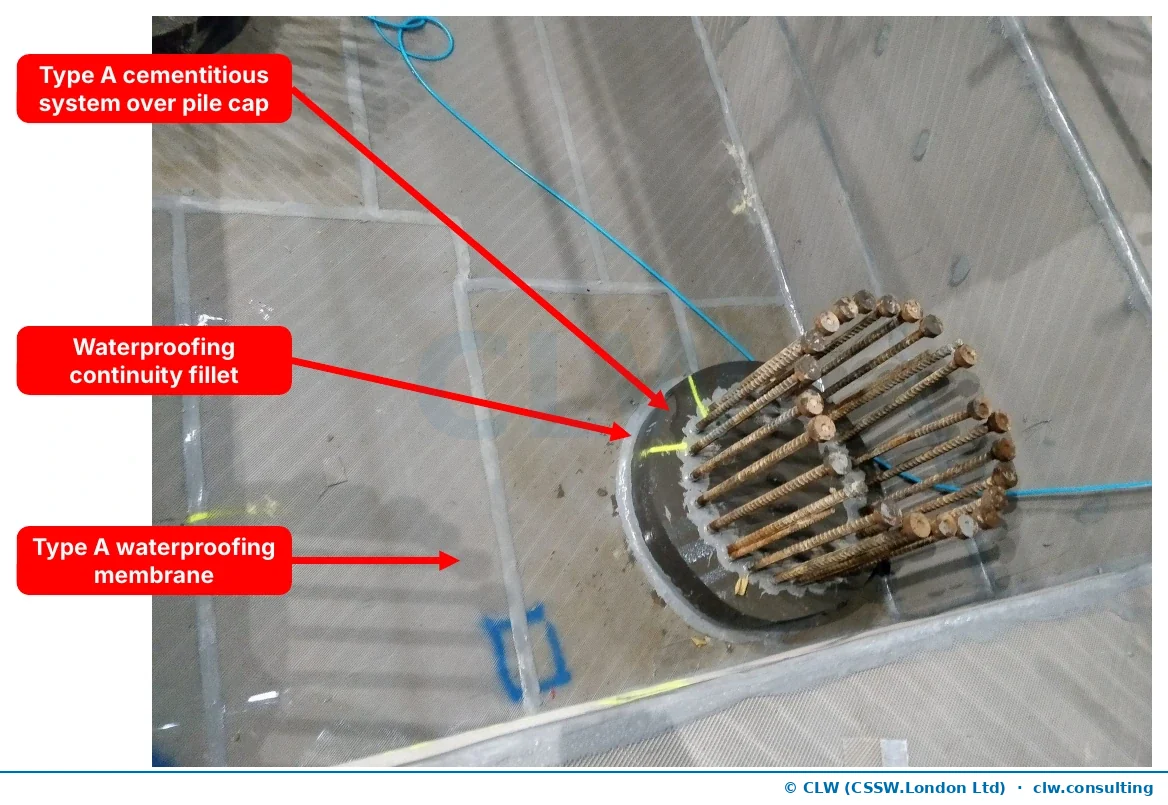
This is what continuity through a pile cap looks like when it has been designed: the sheet membrane cannot wrap the projecting reinforcement, so a second, cementitious system covers the pile cap and a fillet joins the two.
Can Type A be used on its own?
That depends on the grade, the water table and the consequence of a leak, not on the product. See is combined protection required for Grade 3? Where Type A is combined with Type B concrete, the barrier should be bonded.
Related detail: how to terminate a membrane, mixing products from different manufacturers, and Type A, B and C compared. For a view on a live scheme, the Waterproofing Wisdom agent will take plans and a ground investigation.
Frequently asked questions
What is Type A waterproofing?
Type A is barrier protection under BS 8102:2022: a separate waterproofing barrier applied to the structure, externally or internally, through which water should not pass. It includes pre-applied and post-applied sheet membranes, liquid-applied membranes, bentonite and polymer core liners, mastic asphalt, and cementitious coatings and renders.
Is Type A waterproofing the same as tanking?
Broadly, yes. BS 8102:2022 uses tanking to mean applying a waterproofing barrier to the walls, base slab and any buried deck so that the whole below-ground envelope is protected - a Type A approach. A cavity drain membrane is not tanking.
Is a Type A membrane the same as a DPM?
No. A damp-proof membrane is typically a loose-laid polyethylene sheet intended to resist moisture, not water under pressure. NHBC's guidance is explicit that plain polyethylene sheet is not a waterproofing system. A Type A membrane is tested to different standards and should be fully bonded to the structure.
Why does a Type A membrane need to be fully bonded?
So that water reaching a defect in the membrane cannot travel sideways behind it to find a crack or joint in the concrete. With a full bond, a leak needs a membrane defect and a concrete defect in the same place, and the crack can be injected. With a partial bond, the leak inside bears no relation to the defect outside.
Can one membrane be both the waterproofing and the ground gas barrier?
It can, and it is often asked to be. It is two specialist jobs from one installation, each with its own standard, detailing and verification, so it needs a designer who understands both. Continuity that might be acceptable for water alone may not be acceptable where ground gas has to be managed.
Related guidance
- BS 8102 Performance Grades Are a Design Tool, Not a Review Standard
The four performance grades in BS 8102:2022 Table 2 specify what a basement must achieve. They are not a diagnostic tool for reviewing exist
- What Does BS 8102 Require for Waterproofing Design on Commercial Basements?
What BS 8102:2022 recommends for commercial basement waterproofing design, from the specialist appointment and risk assessment to grades, sy
- The BS 8102:2022 Waterproofing Guide
A single sweep through the most-missed clauses, Table 2 grade selection, Type A/B/C combinations, and the combined-protection misconception.
Working on a live scheme?
Put our AI agent to work. It'll reason through your specifics from BS 8102:2022 and land on a defensible recommendation.