

Knowledge · Standards
Is Combined Protection Required for a Grade 3 Basement?
BS 8102:2022 does not make two forms of waterproofing mandatory for Grade 3. It recommends combined protection where the risk or the consequence of failure is too high. NHBC goes further for new homes. What each actually says, and why two systems are still the usual answer.
By Ben Hickman - contributing member, BS 8102:2022 committee · Last updated 17 November 2026 Prepared for the Institution of Structural Engineers webinar "Waterproofing new-build basements: systems, risks and watertight performance", 17 November 2026.
Is combined protection required for Grade 3?
Not by BS 8102:2022 as a blanket rule. The standard recommends combined protection where a single system would leave the assessed risk high, or where the consequences of not achieving the internal environment are too high. For most dry, finished basements that test is met, which is why two forms are so common at Grade 3. It is the result of a risk assessment, not a rule to quote.
This page is part of our guide to waterproofing design for new-build basements. The grade itself is explained at Grade 3.
In brief
- BS 8102:2022 does not mandate two systems for Grade 3; it recommends them where risk or consequence is too high.
- NHBC does require a combined system for Grade 3 with more than 600 mm retained, on warranted new homes.
- Combined systems should fail in different ways; Type A with Type B should be bonded.
- A single system can be defensible if the reasoning is recorded.
Full explanation
Where “Grade 3 needs two systems” comes from
It is repeated so often that it is taken for the standard. Three things feed it.
Warranty requirements. For new homes, NHBC requires a combined system where a Grade 3 environment is needed and more than 600 mm of ground is retained. There is one exception: where the water table is shown to be permanently below the underside of the lowest slab, in-situ Type B concrete alone is acceptable. That is a benchmark for warranted housing. It does not apply to a commercial basement unless the contract adopts it.
Type B concrete. BS 8102:2022 links Type B concrete only to Grades 1a and 1b through the Eurocode tightness classes. A Type B structure enclosing a higher-grade space needs additional measures. So a basement built in waterproof concrete does reach a second system through the standard itself.
The risk assessment usually lands there. A dry, finished, occupied space below the water table, where a leak means stripping out fit-out: the consequence of failure is high, and the standard’s test for combined protection is met.
What the standard does not say is that Grade 3 equals two systems regardless of the ground, the structure and the use.
What counts as combined protection
Combinations of Type A, B and C: A+B, A+C, B+C, A+B+C, and A+A. Two conditions matter. The systems should have different performance characteristics, so that they do not share a failure mode. And where Type A is combined with Type B, the barrier should be bonded.
Why combine at all
Because defects should be assumed in every system. A Type A membrane will have a hole in it somewhere. Type B concrete will have a crack or a poorly compacted patch somewhere. Neither should be expected to be perfect.
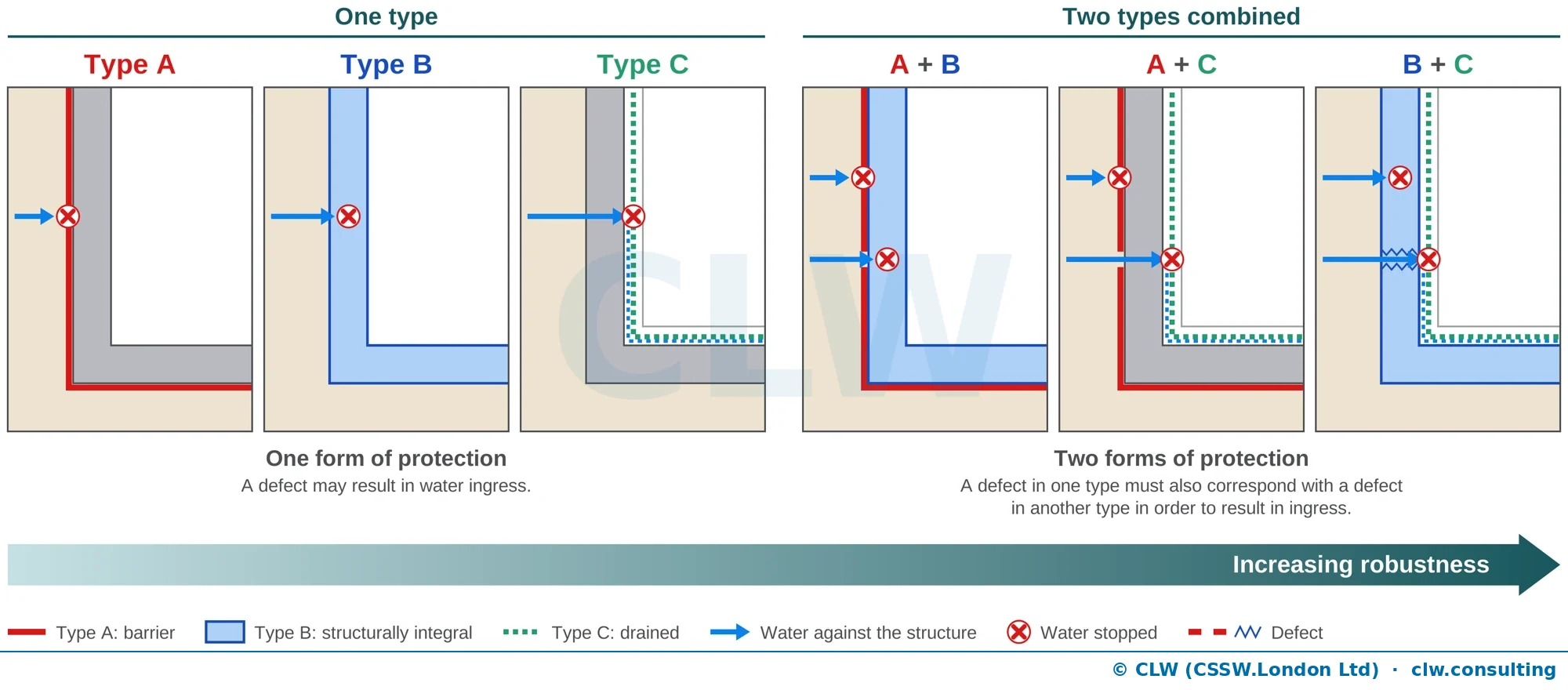
Combine two systems that fail in different ways and a leak needs two defects in the same place. That is the whole argument, and it is a sound one.
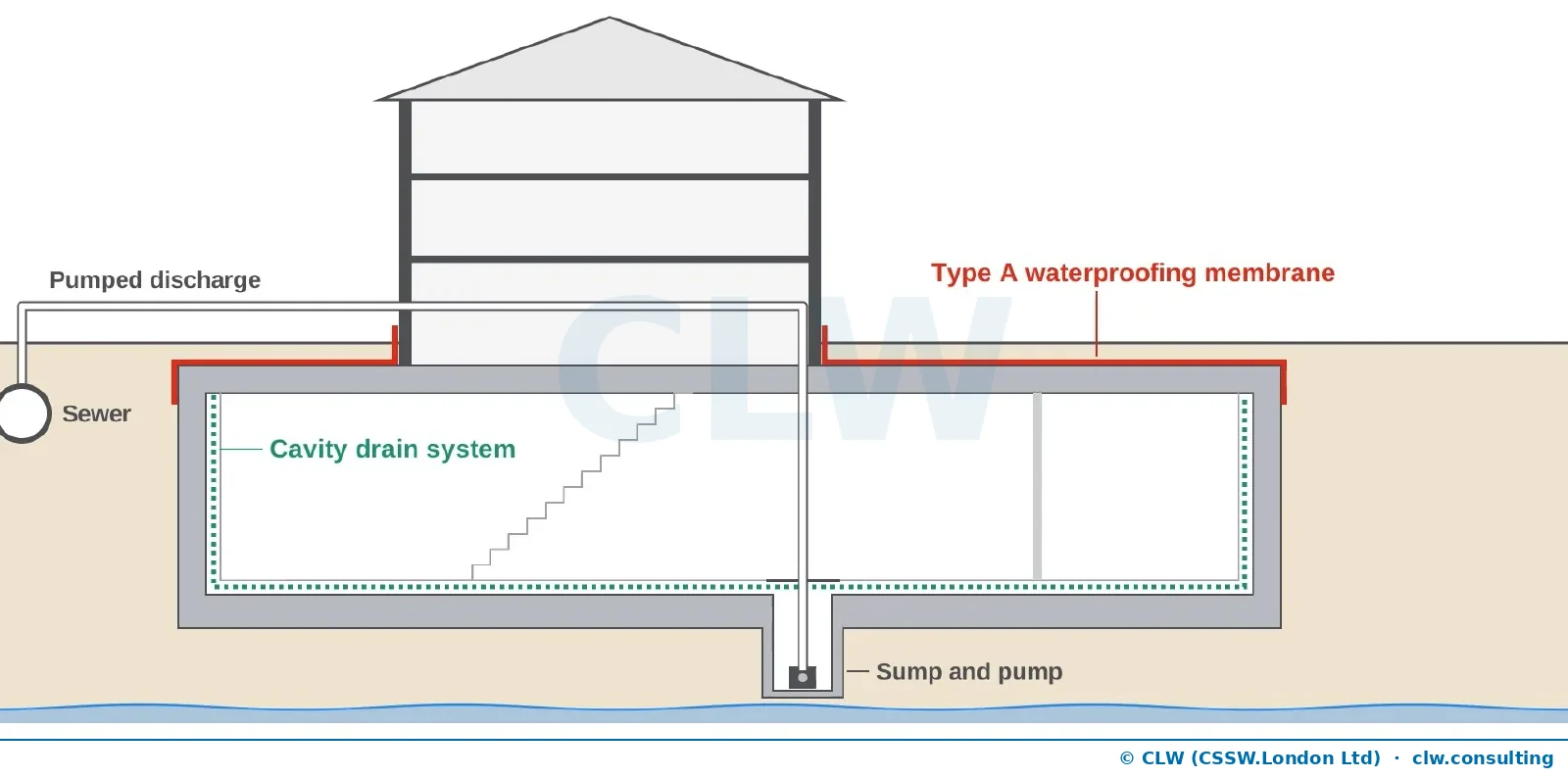
Can a cavity drain system be used on its own?
A cavity drain system manages water; it does not exclude it. The structure still has to limit how much arrives, and leaking joints and penetrations should be dealt with first. In a new basement it is normally paired with a structure designed to keep water out. We are not letting the water in. We are excluding it, and giving it somewhere to go if it gets past.
See what a Type C design covers.
The designer’s position
If a designer relies on a single form of protection for a dry, finished space and something goes wrong, that designer is in an uncomfortable position unless the reasoning was written down. If the reasoning was written down - the water table, the structure, the access for repair, the consequence of a leak - a single system can be a defensible decision. Either way, show the working.
Related: how each type fails and how water risk is assessed under BS 8102:2022. For a view on what a specific scheme needs, the Waterproofing Wisdom agent will take plans and a ground investigation, or see structural waterproofing design.
Frequently asked questions
Is combined protection required for Grade 3?
Not by BS 8102:2022 as a blanket rule. The standard recommends combined protection where a single system would leave the assessed risk high, or where the consequences of not achieving the internal environment are too high. For most dry, finished basements that test is met, which is why two forms are so common at Grade 3 - but it is the result of a risk assessment, not a rule to quote.
Does BS 8102 require two forms of waterproofing?
No. BS 8102:2022 recommends selecting one or a combination of Type A, B and C protection, and recommends a combination where one system alone would leave the risk or the consequence of failure too high. It is a code of practice that recommends; the decision is a recorded risk assessment.
Does NHBC require combined waterproofing?
For new homes under NHBC warranty, a combined system is required where a Grade 3 environment is needed and more than 600 mm of ground is retained. The stated exception is where the water table is shown to be permanently below the lowest floor slab, where a Type B in-situ concrete system alone is acceptable. That is a warranty benchmark for housing, not a requirement of BS 8102:2022.
Is Type A plus Type A combined protection?
BS 8102:2022 lists A+A among the combinations, provided the two systems have different performance characteristics. NHBC does not accept Type A plus Type A as a combined system for warranty purposes.
Related guidance
- BS 8102 Performance Grades Are a Design Tool, Not a Review Standard
The four performance grades in BS 8102:2022 Table 2 specify what a basement must achieve. They are not a diagnostic tool for reviewing exist
- What Does BS 8102 Require for Waterproofing Design on Commercial Basements?
What BS 8102:2022 recommends for commercial basement waterproofing design, from the specialist appointment and risk assessment to grades, sy
- The BS 8102:2022 Waterproofing Guide
A single sweep through the most-missed clauses, Table 2 grade selection, Type A/B/C combinations, and the combined-protection misconception.
Working on a live scheme?
Put our AI agent to work. It'll reason through your specifics from BS 8102:2022 and land on a defensible recommendation.