

Knowledge · Standards
Does a Waterproofing Admixture Make Concrete Waterproof?
No. A water-resisting admixture supplements a Type B design; it does not replace it. What admixtures do, what their certificates say, five checks before relying on a supplier's crack-width figure, and who carries the liability when the wall leaks. Written for structural engineers, from the Institution of Structural Engineers webinar of November 2026.
By Johnny Etkind and Ben Hickman - PCA-registered Waterproofing Design Specialists, CLW · Last updated 17 November 2026 Prepared for the Institution of Structural Engineers webinar "Waterproofing new-build basements: systems, risks and watertight performance", 17 November 2026.
Does a waterproofing admixture make concrete waterproof?
No. A water-resisting admixture reduces how much water hardened concrete absorbs through its pores. It does not control cracks, joints or voids, which is where basements leak. Under BS 8102:2022 concrete is Type B because of its structural design; the admixture supplements that design and does not replace it.
This is the question underneath Type B waterproofing, and part of waterproofing design for new-build basements.
In brief
- An admixture reduces absorption through the pores. It does not control cracks, joints or voids.
- It supplements the Eurocode crack-width design and does not replace it.
- Five checks apply before a supplier crack-width figure is relied on; if any fails, design to 0.2 mm or less.
- Design liability sits with whoever designs the structure, not with a product.
Full explanation
The failure this page is about
The pattern we see on too many projects:
- The engineer specifies “waterproof concrete”.
- A supplier states a crack width its admixture can cope with, often 0.3 mm.
- That statement is treated as the crack-control design.
- Nobody carries out the Eurocode calculation.
Responsibility has slipped into a gap between engineer and supplier that neither believes they own. It happens because product literature reads like a design justification, because waterproofing is assumed to be someone else’s specialism, and because fee, programme and embodied carbon all push towards less steel.
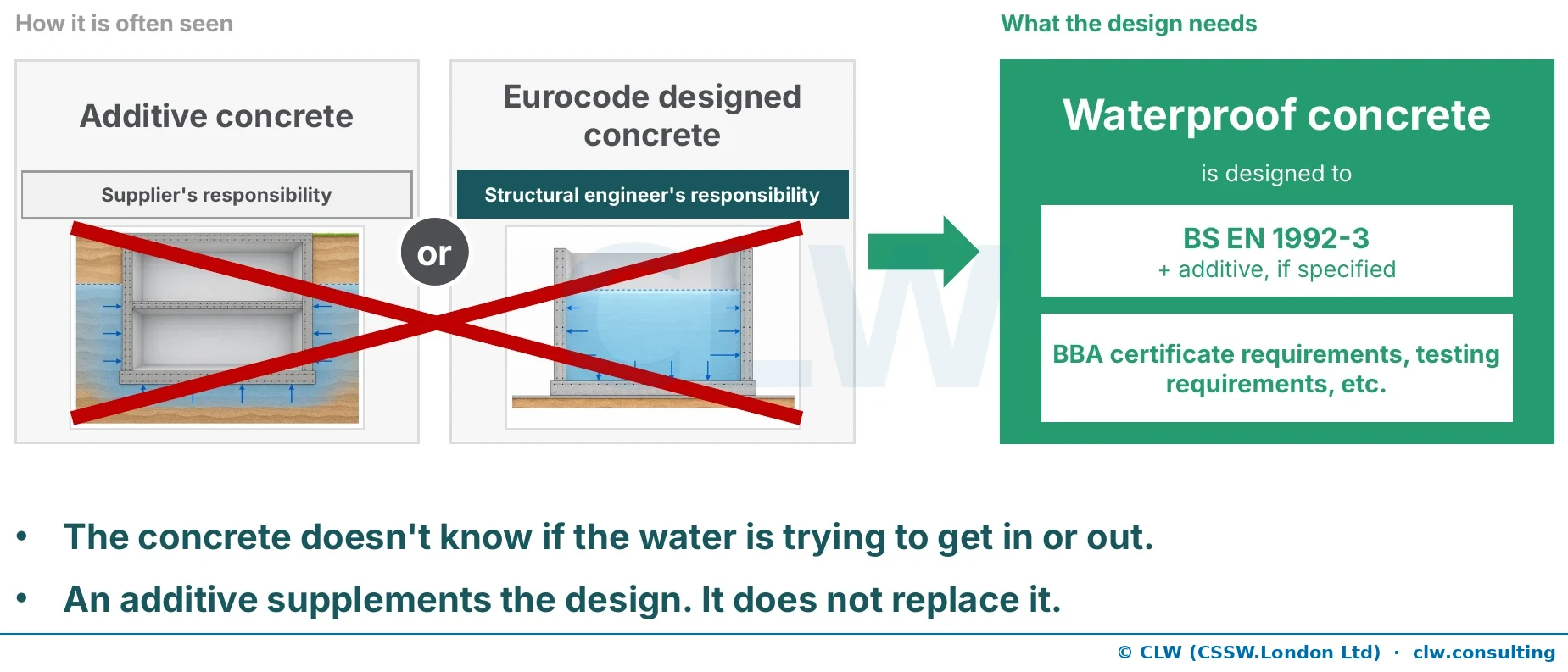
The concrete does not know whether the water is trying to get in or out. An engineer designing a water tank would not skip the liquid-retaining design on the strength of a data sheet. A basement wall with groundwater against it is the same problem.
What an admixture does
The standard’s own definition is modest: an admixture that reduces the capillary absorption of hardened concrete. Three mechanisms are sold. Hydrophobic admixtures line the pores with a water-repellent film. Pore-blocking admixtures fill them with fine inert particles. Crystalline admixtures react with water and unhydrated cement to grow crystals in pores and fine cracks, and can go on doing so when water arrives later.
Trade guidance is direct about the limit: admixtures act on the cement paste and will not significantly reduce water passing through cracks or poorly compacted concrete, which are the two commonest causes of leaks.
What the standard and the certificates say
BS 8102:2022 allows concrete containing an assessed and certified admixture to be treated as having lower water and vapour transmission, provided the mix and casting are properly supervised. It also says the certification defines the limits of the benefit. So the certificate has to be read, not just cited.
In our experience, certificates commonly refer the designer back to the Eurocodes and BS 8102 for the structural design, and some require project-specific testing. The headline crack-width figure in the brochure usually comes with those conditions attached.
Five checks before relying on a supplier’s crack-width figure
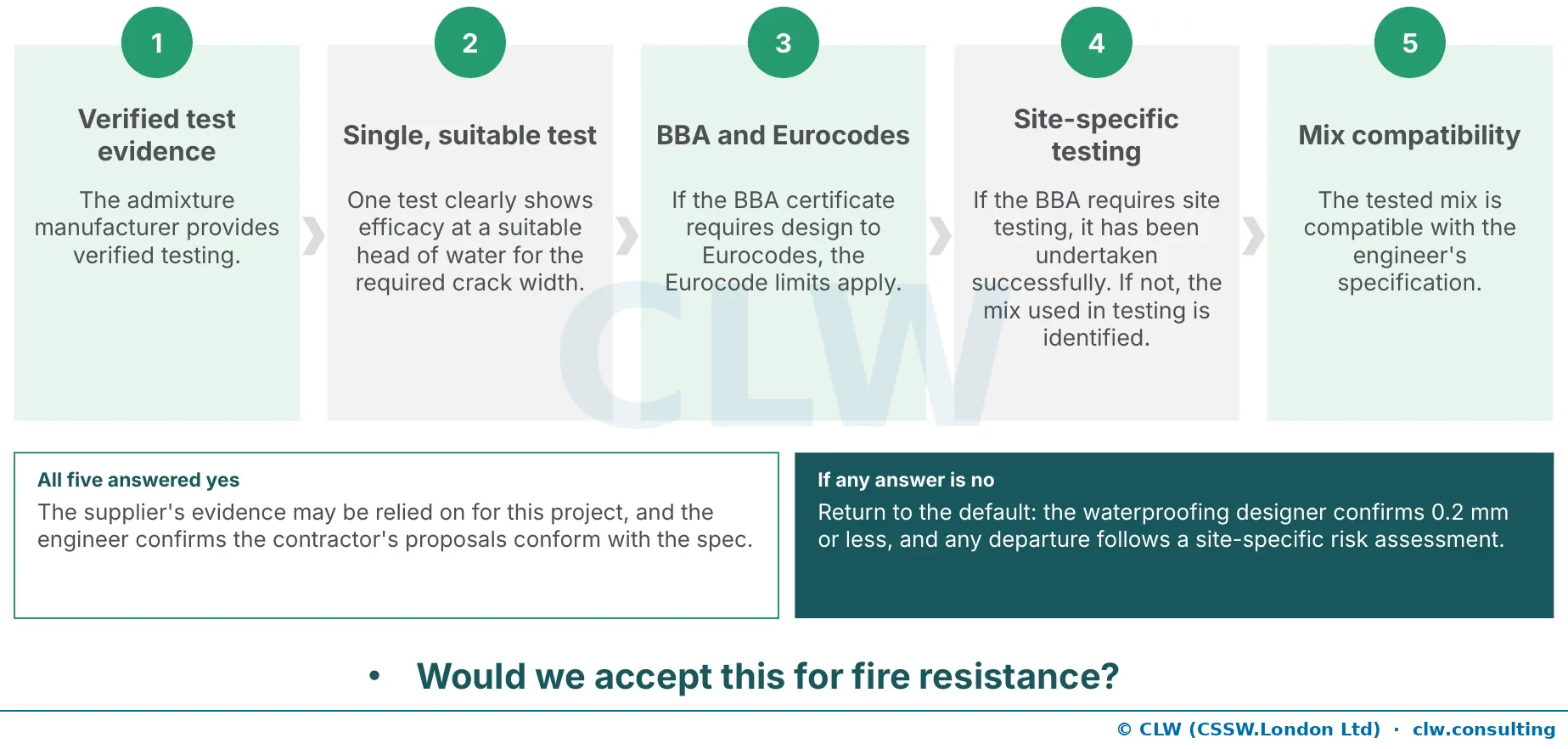
- Verified test evidence. Has the manufacturer provided it?
- A single, suitable test. Does one test show performance at a suitable head of water and at the crack width proposed? The evidence we are usually shown is uncracked concrete at high pressure, or cracked concrete at low pressure, which is not the condition the wall will see.
- The certificate and the Eurocodes. If the certificate requires design to the Eurocodes, the Eurocode limits apply.
- Site-specific testing. If the certificate requires it, has it been done successfully? If not, which mix was tested?
- Mix compatibility. Is the tested mix compatible with the engineer’s specification?
If all five are answered yes, the supplier’s evidence may be relied on for that project. If any answer is no, the default applies: the waterproofing designer confirms a through-crack width of 0.2 mm or less and the structure is designed to it, with any departure following a project-specific risk assessment.
Would we accept this for fire resistance? If a product claimed three hours, we would want test evidence relevant to the application. Water ingress into a finished basement is less dangerous than fire, but it still means tenants out, fit-out stripped and months of resin injection.
The full route, on one page
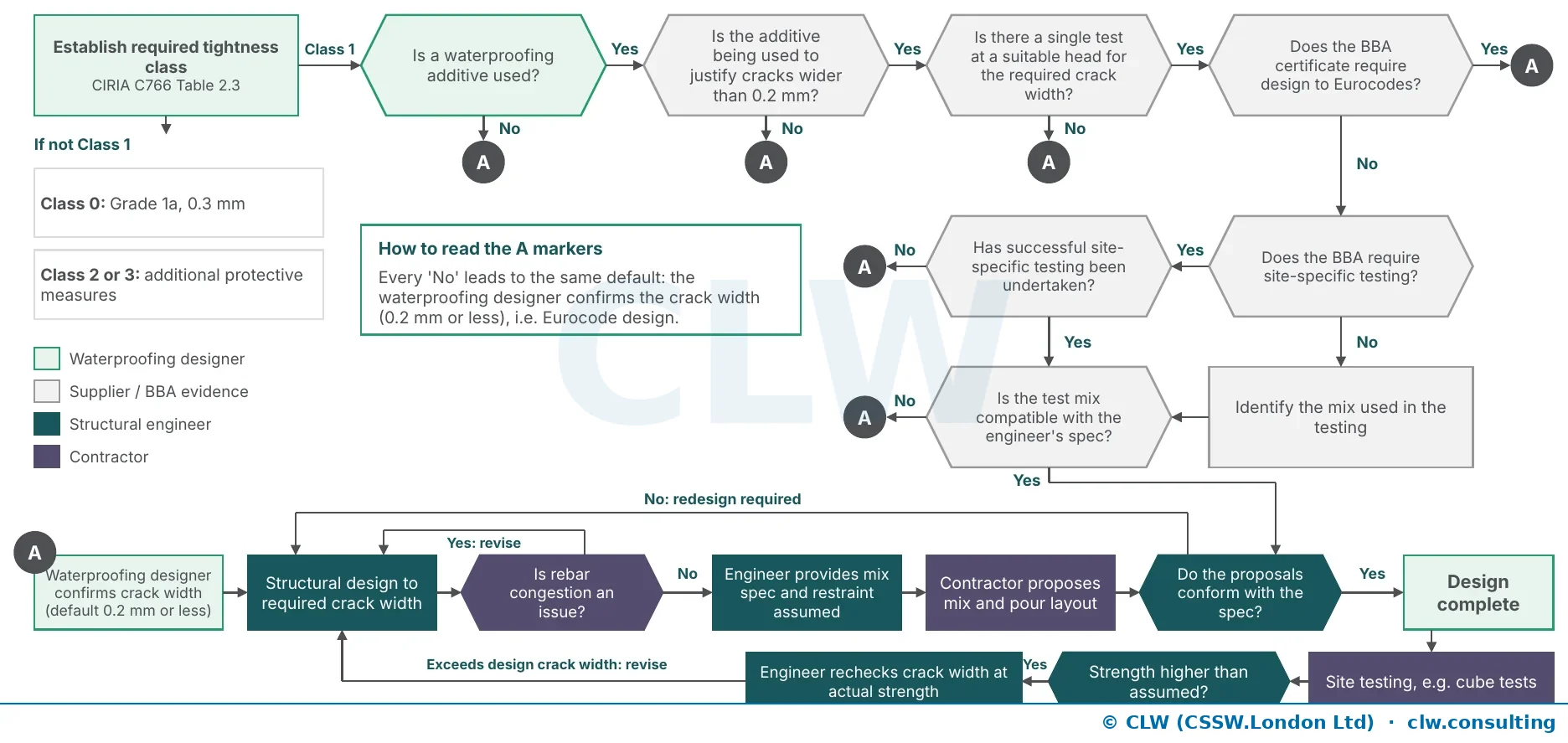
Almost whichever route is taken, the process returns to the Eurocode design. For how tight that design needs to be, and what to do when the reinforcement becomes unbuildable, see the Eurocode 2-3 problem.
Who is responsible if it leaks
A data sheet is not a substitute for a signed crack-control calculation. Design liability sits with whoever designs the structure; it cannot be assigned to a product. The split of responsibility between waterproofing designer, structural engineer, contractor and supplier is set out on the Type B page and in the design responsibility matrix.
What the warranty is worth
Ask for a specimen warranty and read it. Nearly all are material warranties, so the claimant has to prove the material itself failed, and the value is often capped at the value of product sold. Design teams sometimes spend years saying “we must do this to keep the warranty” about a document worth less than they think. See why supplier warranties do not replace design.
Asked by structural engineers at the IStructE webinar
“What is your experience of admixture supplier warranties when Type B structures containing an admixture do leak?”
Varied. Some cover a 0.2 mm crack, some 0.3 mm. With most reputable suppliers someone will come out and inject the cracks, which makes commercial sense for them and is often not expensive. But read the warranty itself: nearly all are material warranties, capped at the value of product sold, with no relevance to consequential loss or to the cost of finding out what went wrong. The confidence a design team places in the warranty is usually greater than its value on paper.
What to do on your next basement
- Ask early: who owns the crack-width design?
- Ask for evidence: does the admixture’s test evidence fit our head of water and our crack width?
- Involve the specialist: bring the waterproofing designer in at concept stage, so the design head and the crack-width limit are set before the reinforcement is detailed.
If you have a Type B basement at Stage 3 or 4 and are unsure where it stands, put the section, head and grade to the Waterproofing Wisdom agent, or see structural waterproofing design.
Frequently asked questions
Does a waterproofing admixture make concrete waterproof?
No. A water-resisting admixture reduces how much water hardened concrete absorbs through its pores. It does not control cracks, joints or voids, which is where basements leak. Under BS 8102:2022 concrete is Type B because of its structural design; the admixture supplements that design and does not replace it.
Is concrete with a waterproofing admixture Type B?
Not on that basis alone. BS 8102:2022 allows concrete with an assessed and certified admixture to be treated as having lower water and vapour transmission, and says the certification defines the limits of that benefit. Type B status still depends on the complete design: design head, crack control to BS EN 1992-3, joints, mix and placement.
Can an admixture justify designing to a 0.3 mm crack width?
Only if the evidence fits the project. Check that verified testing exists, that a single test covers both the head of water and the crack width proposed, what the certificate says about Eurocode design and site-specific testing, and that the tested mix matches the engineer's specification. If any of those fails, the Eurocode design governs.
Do I still need waterstops if the concrete has an admixture?
Yes. BS 8102:2022 recommends waterstops at construction joints and penetrations, forming a continuous network. An admixture acts within the concrete; a construction joint is a gap between two pours.
What is an admixture supplier's warranty worth if the concrete leaks?
Read it before relying on it. Most are material warranties: the claimant has to show the material itself failed, and the value is often capped at the value of product sold, with nothing for investigation or consequential loss. Reputable suppliers will often attend and inject cracks, which is useful, but it is not design liability.
The cube results came back stronger than the design strength. Does that matter for watertightness?
It can. The crack-width calculation assumed a concrete strength. If the concrete achieved is materially stronger, the engineer should recheck the crack width at the actual strength, because the reinforcement may no longer control cracking to the width intended.
Related guidance
- BS 8102 Performance Grades Are a Design Tool, Not a Review Standard
The four performance grades in BS 8102:2022 Table 2 specify what a basement must achieve. They are not a diagnostic tool for reviewing exist
- What Does BS 8102 Require for Waterproofing Design on Commercial Basements?
What BS 8102:2022 recommends for commercial basement waterproofing design, from the specialist appointment and risk assessment to grades, sy
- The BS 8102:2022 Waterproofing Guide
A single sweep through the most-missed clauses, Table 2 grade selection, Type A/B/C combinations, and the combined-protection misconception.
Working on a live scheme?
Put our AI agent to work. It'll reason through your specifics from BS 8102:2022 and land on a defensible recommendation.