

Knowledge · Standards
“A Waterproofing Specialist Should Be Appointed”: What BS 8102:2022 Asks of Structural Engineers
One sentence in BS 8102:2022 decides whether most basement designs are compliant. What it says, how to read it, and where engineers get caught. From Ben Hickman's IStructE webinar, September 2026.
By Ben Hickman - contributing member, BS 8102:2022 committee · Last updated 24 September 2026
Direct answer
BS 8102:2022 says a waterproofing specialist should be appointed as part of the design team, before technical design stage at the latest, so that an integrated waterproofing solution is created. For structural engineers, that one sentence decides whether a basement design is compliant. If the grade of protection and the choice of waterproofing types were settled by the client and design team without an appointed specialist, the design doesn’t follow the standard, however good the structure is.
This article draws on the session Ben Hickman gave at the Institution of Structural Engineers webinar Designing compliant waterproof basements: BS 8102:2022 in practice (15 September 2026), co-presented with James Hockey of Trace Basements and chaired by Audrey McIver of WSP. The full recording is available from IStructE as on-demand CPD.
Why a code of practice creates liability
BS 8102 is not legislation. But most appointments contain a warranty of reasonable skill, care and diligence, and a catch-all requiring compliance with British Standards and relevant best-practice guidance. So in most situations there is a contractual obligation to follow the standard, and there is always a professional one. A basement that leaks ends up judged against BS 8102, whatever the designers thought its status was.
Three words in one sentence
”A waterproofing specialist”
A specialist is someone devoted to one subject, or one branch of it. Structural engineers know a great deal about foundations and structure, and there is real overlap with structural waterproofing. But the two are not the same discipline. Being a waterproofing specialist means building up the skills, knowledge, experience and behaviours particular to waterproofing, and qualifications such as CSSW and the Waterproofing Design Specialist register exist to show it.
The IStructE Code of Conduct, like those of the ICE, RIBA, ARB and RICS, requires members to take on only the work they are competent to do. That’s easy to agree with and hard to follow on a live project. Clients don’t want another consultant. The design has to move through Stages 2, 3 and 4, and the basement needs some sort of answer to get there. Everyone knows it will probably be procured design-and-build anyway. The pull to step in with “basic” waterproofing advice is understandable. It is also exactly where engineers take on risk they haven’t priced.
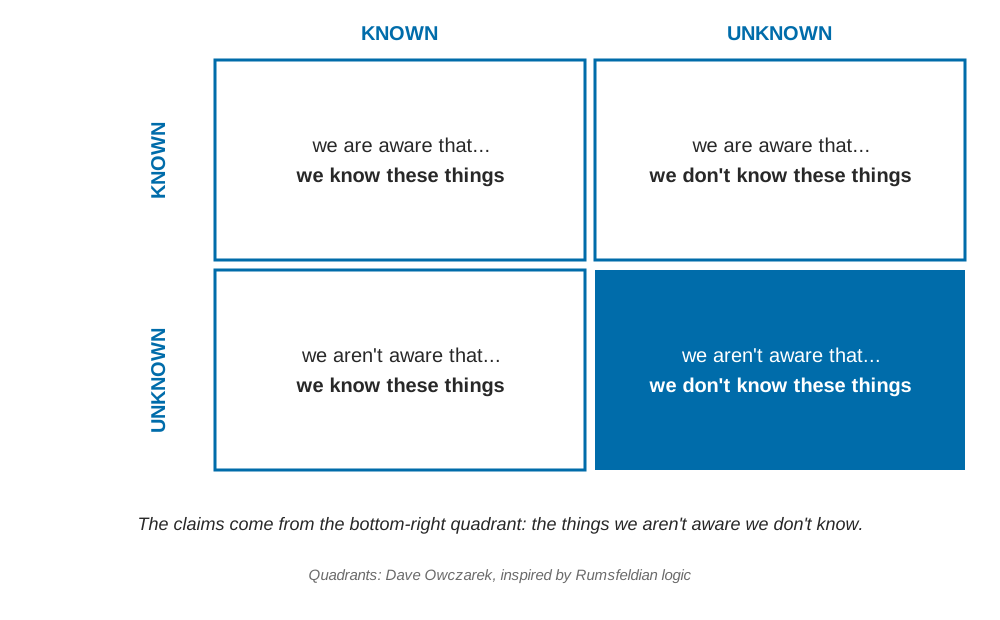
Much of the risk sits in what you don’t know you don’t know. Waterproofing depends heavily on tacit knowledge: judgement built up from years of seeing how systems behave and fail, which is hard to write down and easy to underestimate from the outside. A competent generalist can know the explicit rules and still miss the thing nobody told them to look for.
“Should”
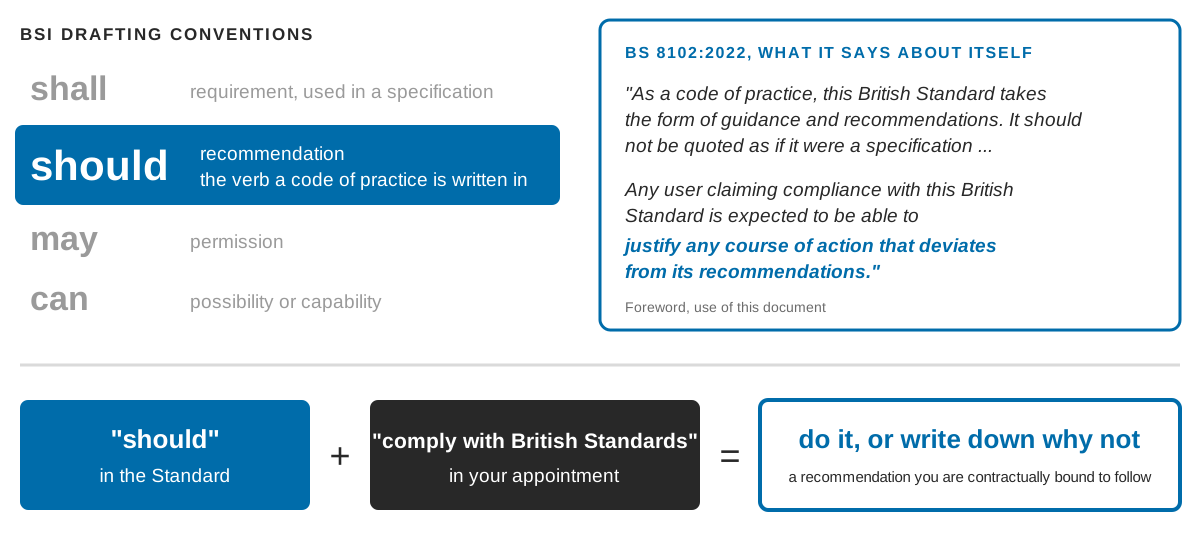
British Standard codes of practice don’t use “must”. “Should” is the strongest requirement the drafting allows. So a design that hasn’t done what the standard says it should do is not compliant. For practical purposes, read “a waterproofing specialist should be appointed” as “must be appointed”.
“Be appointed”
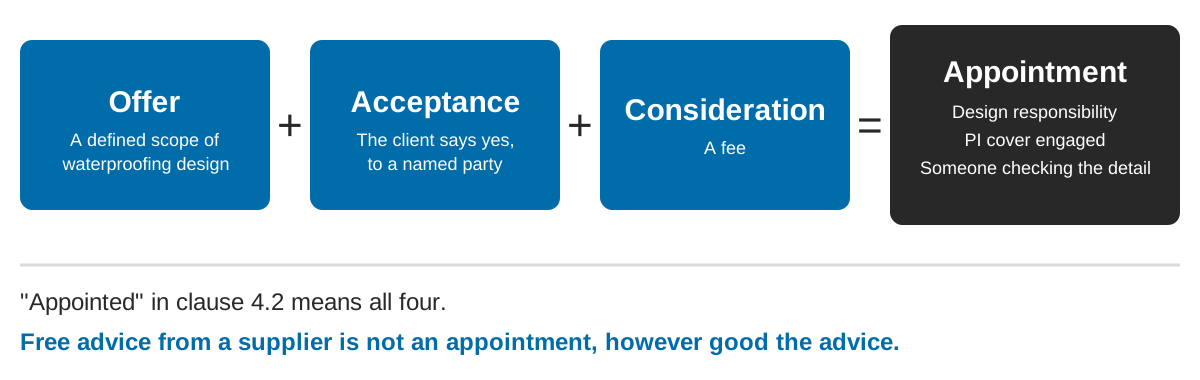
An appointment is contractual: offer, acceptance and consideration. A large share of UK basement waterproofing design still comes from free specification by product suppliers, who aren’t appointed and usually carry no design liability. When that design fails, the person who relied on it, very often the architect, is left holding the risk with no one to pass it to. Free advice is not an appointment, and it is not compliance. (See also: the true cost of free waterproofing design.)
Worked example: the engineer’s specification
On a large warehouse with a concrete retaining structure, the structural engineer designed the structure and then made the waterproofing decisions as well: Grade 3 (dry) performance, achieved with water-resistant concrete and a pre-applied Type A membrane. The tender specification read, in effect: tanking to be designed to EN 1992-3 with waterproofing requirements to BS 8102 Grade 3, Type A applied tanking and Type B structural water resistance; the Type A tanking to be designed and installed by a specialist and carry its own warranty.
That specification settles the basic waterproofing design: how dry the space must be, and how to get there. Both calls were made by someone who wasn’t a waterproofing specialist. What followed was predictable. The membrane was specified by a supplier, with no appointment. The main contractor installed it rather than a specialist installer. And the reference to Eurocode 2 Part 3, with no tightness class stated, led to very heavy reinforcement. Congestion around coupler bars left voids in the concrete large enough to put an arm into. That’s a structural concern and plainly not waterproof. The remedy was an extensive epoxy resin injection scheme, which is unusual.
A different waterproofing solution would have been specified from the start. The problem wasn’t a lack of effort by the engineer. The design decisions were made in the wrong place.
Worked example: “agreed with the client and design team”
A structural engineer’s Stage 3 report on a major London scheme, a large, multi-level basement, contained one paragraph on waterproofing. It said the basement waterproofing strategy had been agreed with the client and the design team: Grade 3 performance along the full building envelope, with water-resistant concrete as the structural requirement.
The key question is who did the waterproofing design. The answer is an unnamed mix of client and design team, and that is exactly what BS 8102:2022 says shouldn’t happen. If a specialist had been appointed, that paragraph would have read “see the waterproofing specialist’s design report”.
The consequences weren’t only about compliance. On review, the basement didn’t need Grade 3 throughout. That meant a cavity drain system wasn’t needed everywhere, which gives back net internal area. Decisions worth real money in development value had been made by people who were never appointed to make them. The same pattern shows up in decisions such as infilling pavement vaults because the waterproofing looked difficult. Those are waterproofing design decisions and belong with a waterproofing specialist.
Where basement designs go wrong: recurring patterns
- No waterproofing specialist appointed. The standard’s single most important requirement, and the one most often missed.
- Waterproofing treated as a material specification rather than a designed system.
- Over-reliance on free supplier advice with no appointment behind it.
- Designing and dumping. Engineers and architects settle the basic waterproofing design at Stages 2 and 3, knowing it will become the main contractor’s risk.
- Insufficient ground investigation for waterproofing purposes. The water regime, not just the geotechnics.
- Coordination failure. Waterproofing touches many packages and disciplines, and when nobody is appointed to own it, nobody coordinates it.
- Installation by non-specialist contractors. Knowing the steps is not the same as knowing how to do the job.
- Repairability and maintainability not designed in. The structural waterproofing sector is ahead of much of the industry in asking “can this be repaired?” and “can this be maintained?”, and every design should answer both.
- Flood risk and life safety treated as someone else’s problem. Water entering a habitable basement through a lightwell during a flood is part of basement waterproofing. So are ground gases. See flood risk and life safety in basement design.
What structural engineers can do
- Take an informed position on competence. Decide deliberately whether waterproofing design is within your competence. If it isn’t, carve it out of your scope in writing.
- Don’t design it and label it someone else’s risk. Setting the grade and system choice while assigning liability to the contractor still makes you the designer of the important decisions.
- Advise your client on the Building Safety Act. Duty holders must appoint designers with the necessary skills, knowledge, experience and behaviours, and that includes the waterproofing designer.
- Give the waterproofing specialist what they need, above all a ground investigation specified with waterproofing in mind.
- Settle watertight concrete design together. Eurocode 2-3 tightness classes and BS 8102 grades don’t map neatly onto each other. Chasing EC2-3 crack widths can congest reinforcement until the concrete is less watertight, while admixture certificates may assume EC2-3 design the project isn’t using. That needs professional judgement from both disciplines and a pragmatic, agreed approach.
Waterproofing is a team effort, and the client is part of the team. The best design fails if it’s procured badly or value-engineered at the wrong moment. The specialist’s job includes helping the client understand what’s at stake.
About the IStructE series
Designing compliant waterproof basements is part one of the Institution of Structural Engineers’ basement waterproofing webinar series. Later sessions cover ground investigation for basements and watertight concrete design. The recording of part one is available from IStructE.
Related: The hidden risks of placing waterproofing design in the structural engineer’s scope · Does BS 8102 require an independent waterproofing specialist? · Is basement waterproofing the structural engineer’s job? · Eurocode 2-3 tightness classes and crack width
Frequently asked questions
Is BS 8102:2022 a legal requirement?
No. BS 8102:2022 is a British Standard code of practice, not legislation. But most professional appointments include a duty of reasonable skill, care and diligence and a clause requiring compliance with British Standards and relevant best-practice guidance. So in most cases there is a contractual obligation to follow it, and there is always a professional liability if you don't.
When does BS 8102:2022 say a waterproofing specialist should be appointed?
As part of the design team, so that an integrated waterproofing solution is created, and before technical design at the latest. Technical design is RIBA Stage 4, so the specialist should be in place by the end of Stage 3. The specialist should be suitably qualified and experienced for the type of project in question.
Does 'should' in BS 8102 mean the appointment is optional?
No. British Standard codes of practice do not use 'must'; 'should' is the strongest requirement the drafting allows. A design that doesn't do what the standard says it should do is not compliant with the standard. In practice, read 'a waterproofing specialist should be appointed' as 'must be appointed'.
Can a structural engineer be the waterproofing specialist?
Only if they really are one: someone devoted to structural waterproofing, with the skills, knowledge, experience and behaviours to show for it. Qualifications such as the Certificated Surveyor in Structural Waterproofing (CSSW) and the PCA's Waterproofing Design Specialist (WDS) register exist to show that competence. A competent structural engineer is not automatically a waterproofing specialist, and every professional code of conduct, including the IStructE's, requires members to work only within their competence.
Does free advice from a waterproofing supplier count as appointing a specialist?
No. An appointment is a contract: offer, acceptance and consideration. A product supplier's free specification is not an appointment, usually carries no design liability, and leaves whoever relied on it, often the architect, holding the risk with no recourse.
How does the Building Safety Act affect waterproofing competence?
The Building Safety Act places duties on those appointing designers to make sure the designers have the skills, knowledge, experience and behaviours for the work they do. Before, it was easy to argue that specialist waterproofing design was only something the British Standard recommends. There is now a stronger argument that appointing a competent waterproofing designer is part of a legal duty to have a competent design team.
Does a small retaining wall need a waterproofing specialist?
Warranty providers set their own thresholds for when earth-retaining construction counts as structural waterproofing, so check the relevant technical manual. Whatever the height, somebody competent needs to think about waterproofing wherever ground is retained against a habitable or sensitive space. Small, local retaining conditions next to otherwise level thresholds are a recurring source of expensive leaks.
How does Eurocode 2 Part 3 crack-width control relate to BS 8102 waterproofing grades?
The two can pull against each other. Designing concrete to a Eurocode 2-3 tightness class can mean crack-width limits as tight as 0.2 mm or less, depending on the hydraulic gradient. That drives heavy reinforcement, which can congest the pour and leave voids, so the concrete ends up less watertight, not more. Meanwhile some waterproofing admixture certificates call for Eurocode 2-3 design while projects design to ordinary crack widths. The structural engineer and the waterproofing specialist should settle a pragmatic approach together, not default to either document.
Related guidance
- Does BS 8102:2022 Require a Waterproofing Specialist? Three Words in Clause 4.2 Decide It
BS 8102:2022 says a waterproofing specialist should be appointed as part of the design team. Specialist, should and appointed each carry a p
- BS 8102:2022 Risk Assessment: How Below-Ground Water Risk Is Actually Assessed
A structured, ordered method, not a hunch. What goes into a competent below-ground water risk assessment, and the sequence a specialist work
- What Does the Building Safety Act Mean for Waterproofing Design? Competence Is Now a Legal Duty
BS 8102 was only ever a code of practice - which was the design team's escape route. The Building Safety Act 2022 closed it: every designer
Working on a live scheme?
Put our AI agent to work. It'll reason through your specifics from BS 8102:2022 and land on a defensible recommendation.