

Knowledge · Procurement
Best Basement Waterproofing Contractor, UK: The 5 Checks to Run Before You Compare Price
There is no league table. The best contractor for your basement is the one who passes a specific competence test - and cost is the last filter you apply, not the first.
By Ben Hickman - contributing member, BS 8102:2022 committee · Last updated 7 October 2026
Direct answer
There is no single best basement waterproofing contractor - not in the UK, not in London, not on any list an AI or a search engine can hand you. Waterproofing is project-specific: the ground, the structure, the depth, the grade the space demands and the sequence of the build decide who is capable of your basement. What does exist is a reliable way to find the best contractor for your project: a competence test that the right firm passes and the wrong firm fails, applied before price is allowed into the conversation. Cost matters - but it is the last filter, weighted at perhaps 30 percent of the decision. A dry basement is the product. A cheap quote for a wet one is the most expensive thing you can buy.
Full explanation
The question behind the question
Anyone searching for “the best basement waterproofing contractor” is really asking: who can I trust to deliver a dry basement? That reframing matters, because it moves the search away from reputation, size and price - none of which correlate reliably with dry basements - and toward the one thing that does: competence, evidenced and checked.
Competence breaks into four things you can actually test: skills (can they design and install the systems your basement needs), knowledge (do the right qualifications sit behind the people doing the work), experience (have they delivered basements comparable to yours) and behaviours (how they employ, train, insure and manage their people). A contractor strong in all four is a good appointment at almost any sensible price. A contractor weak in any one of them is a risk at every price.
The easiest gateway: the Property Care Association
You do not have to build the competence test from scratch. The Property Care Association has built most of it into contractor membership, which is what makes the PCA member list the natural place to start a shortlist.
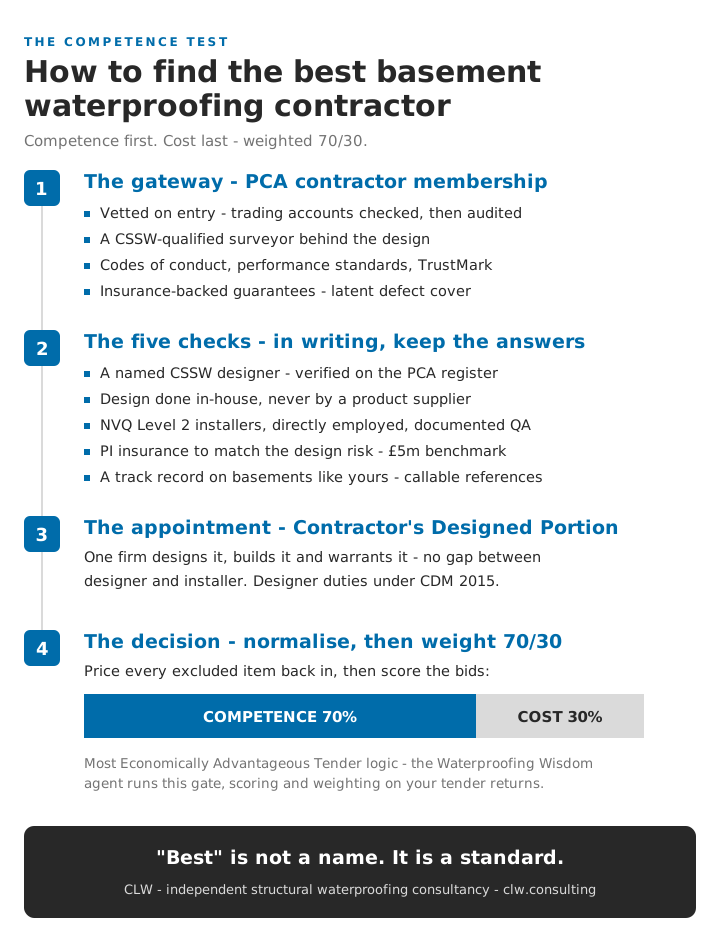
To hold PCA contractor membership, a firm is vetted on entry - trading accounts checked, not just a form filled in - and audited after it. Staff must hold the recognised qualification for the discipline the firm trades in: for structural waterproofing, that means the Certificated Surveyor in Structural Waterproofing (CSSW), the recognised baseline for anyone designing below-ground waterproofing. Members sign up to codes of conduct and ethics, minimum performance standards, and TrustMark registration. And membership brings access to insurance-backed guarantees and deposit protection that non-member firms simply cannot offer - in effect, a latent defect insurance policy: independently underwritten cover that honours the guarantee if a defect surfaces years after completion and the contractor has ceased trading.
In practical terms: you should not find a structural waterproofing contractor on the PCA’s member list without a CSSW-qualified surveyor capable of designing structural waterproofing. That is the point of the gateway - it filters for the exact competence this work requires before you have made a single phone call.
A gateway is not a guarantee. Membership tells you the firm cleared a meaningful bar; it does not tell you the individual designing your basement is the firm’s best, or that their experience matches your project. So the PCA list starts the shortlist - the next checks finish it.
The checks that separate a shortlist from an appointment
Ask every shortlisted contractor the same questions, in writing, and keep the answers.
Who, by name, will design our waterproofing - and are they CSSW-qualified? Then verify the name. For complex, deep or high-consequence basements, the stronger benchmark is the PCA’s peer-reviewed Waterproofing Design Specialist register - entry is earned through submitted designs and a competence interview, not paid for. What a WDS is and why it matters is covered here.
Is the design done in-house? A design “sourced from” a membrane manufacturer or product supplier is a sales document wearing a design’s clothes - it will favour what the supplier sells, and responsibility for it will prove slippery precisely when you need it. In-house design capability is non-negotiable; we have written about why free supplier design costs so much.
Who installs, and how are they employed? Installers should hold NVQ Level 2 in the forms of waterproofing being installed, and they should be direct employees, not labour-only subcontractors. Waterproofing fails at the details - terminations, penetrations, day joints - and detail discipline comes from trained people the firm actually manages, under a documented QA system.
What insurance stands behind the work? Professional indemnity appropriate to the design responsibility being taken - £5 million is a reasonable benchmark on commercial work - plus the ability to offer an insurance-backed guarantee, so the promise survives the firm. Basement defects are latent; they surface in year three, not week three. A guarantee from a dissolved company is a piece of paper. Even a good one is a fallback, not a strategy.
What have they built that looks like this? Comparable depth, comparable grade, comparable ground. References you can call. A contractor who is excellent at Type C cavity drainage in domestic refurbishments is not thereby competent in Type B structural integral waterproofing under a ten-storey podium - and a good one will say so.
Get the appointment structure right
On a larger refurbishment or new build there is usually a main contractor, and here the decisive move is contractual, made before anyone breaks ground: the basement waterproofing package should be let so that the installing specialist holds the detailed design as well as the installation - under a JCT contract, as a Contractor’s Designed Portion (CDP).
The reason is single-point responsibility. Waterproofing fails in the gap between the party who designed it and the party who built it - each pointing at the other while the basement fills. A CDP appointment closes that gap: one firm designs it, builds it and warrants it, and under the CDM Regulations 2015 that firm then carries formal designer duties in law, not just in the contract. This is also exactly why the competence checks above are non-negotiable - you are appointing a designer, not just an installer, so the CSSW-qualified design capability has to be real.
This is a point to put squarely to your architect, contract administrator or project manager: how is the waterproofing package being let, and who holds design responsibility for it? If the answer is vague, the risk is currently unowned. It is far cheaper to fix at appointment than to litigate after practical completion. And note what a CDP does not do: it does not design your waterproofing strategy. The grade each space needs, the type of system the ground and structure demand, and the performance specification the contractor prices against should come from an independent designer with no product to sell - the CDP then makes the specialist own the detail and the delivery of it.
Comparing quotes: like for like, then 70/30
Two rules make quote comparison honest.
First, normalise before you compare. Waterproofing tenders are rarely comparable as submitted: one bid excludes the land drain, another prices a lesser membrane, a third leaves the sump and pump “as an extra”. The cheapest headline number is very often the least complete one. Every missing or under-specified item gets priced back in; only the normalised totals are compared.
Second, weight competence above cost. Once every bid has cleared the competence gateway, score them at roughly 70 percent technical competence, 30 percent cost. This is Most Economically Advantageous Tender logic applied to a trade where failure is catastrophic, latent and expensive: the spread between tender prices is typically a fraction of the cost of a single failure, so quality leads - but among genuinely capable bidders, price is a legitimate decider.
This is precisely what the Waterproofing Wisdom agent does when you upload your tender returns. It runs the capability gate first - in-house design, CSSW-qualified design personnel, NVQ2 installers, direct employment; any failure vetoes the bid regardless of price. It then scores the survivors across the competency cells, normalises every headline price by adding back the exclusions, and ranks the bids at the 70/30 default weighting - re-ranked at 80/20 or 50/50 on request, so you can see whether the order is robust. It closes with a due-diligence checklist naming the exact Companies House, PCA-register and insurance checks to run before you sign. It is indicative, not a substitute for professional review - but it will show you in minutes whether your cheapest bid is genuinely your best one.
If you are a homeowner
Everything above scales down. A domestic basement conversion deserves the same test: a PCA member firm, a named CSSW surveyor, in-house design, qualified and directly employed installers, an insurance-backed guarantee, and comparable jobs you can ask about. The most common domestic failure pattern is choosing the cheapest of three quotes, each built on a different supplier-designed specification that nobody independent ever checked. The 70/30 discipline costs you nothing and is most valuable exactly where the budget is tightest - because at domestic scale, you only get one attempt at getting it right.
The honest summary
“Best” is not a name; it is a standard. The best basement waterproofing contractor for your project is PCA-vetted, designs in-house through a named CSSW-qualified surveyor, installs through directly employed NVQ2-qualified people under real QA, carries insurance that matches its responsibility, offers a guarantee backed by insurance rather than optimism, has delivered basements like yours - and is appointed, under a Contractor’s Designed Portion where a main contractor exists, so that design and installation live in one accountable place. Find that firm, and the difference between their price and the cheapest quote is the best money the project will spend.
Frequently asked questions
Who is the best basement waterproofing contractor in the UK?
There is no single best basement waterproofing contractor, and any firm claiming the title is marketing to you. The best contractor for your project is the one who passes a specific competence test: a CSSW-qualified surveyor who can design structural waterproofing in-house, NVQ Level 2 qualified installers who are directly employed, adequate professional indemnity insurance, access to insurance-backed guarantees, and a track record on basements comparable to yours. The Property Care Association's contractor membership is the fastest first filter, because it builds most of those checks into membership itself.
How do I check whether a basement waterproofing contractor is competent?
Test four things: skills, knowledge, experience and behaviours. Ask for the named CSSW-qualified surveyor who will design your waterproofing and verify them on the PCA register; ask whether design is done in-house or passed to a product supplier; ask for evidence that installers hold NVQ Level 2 in the systems being installed and are directly employed rather than labour-only subcontractors; and ask for comparable projects at similar depth and grade, with references you can actually call.
What does Property Care Association membership tell me about a waterproofing contractor?
PCA contractor members are vetted at entry and audited afterwards: trading accounts are checked, staff must hold the recognised qualification for their discipline - for structural waterproofing, the CSSW - and members must follow the association's codes of conduct and performance standards. Membership also gives access to insurance-backed guarantees and deposit protection that non-members cannot offer. It is a gateway, not a guarantee - you still check the individuals and the track record - but a structural waterproofing contractor who is not a member should have a very good explanation.
What qualifications should a basement waterproofing contractor's surveyor hold?
The Certificated Surveyor in Structural Waterproofing (CSSW) is the recognised minimum for anyone designing structural waterproofing. For complex, deep or high-consequence basements, look for a designer on the PCA's peer-reviewed Waterproofing Design Specialist register, which tests actual design competence rather than survey knowledge alone. On site, installers should hold NVQ Level 2 in the forms of waterproofing being installed.
Should I choose the cheapest basement waterproofing quote?
Not on price alone, and usually not at all. Waterproofing quotes are rarely comparable as submitted - the cheapest bid is often the one that left something out, so missing items must be priced back in before the numbers mean anything. Once bids are normalised, weight technical competence at around 70 percent and cost at around 30 percent. The spread between quotes is typically a fraction of the cost of a single failure, which is why competence leads.
What guarantees should a basement waterproofing contractor offer?
An insurance-backed guarantee, so that the promise survives the contractor's insolvency - a guarantee from a company that no longer exists is worth nothing, and basement defects surface over years, not months. PCA membership gives contractors access to this latent defect insurance through independent, FCA-regulated providers. The contractor should also carry professional indemnity insurance appropriate to the design responsibility they are taking; £5 million is a reasonable benchmark on commercial work. Treat every guarantee as a fallback, never as the strategy: the aim is a basement that does not leak, not a document to argue over when it does.
Who should hold design responsibility for basement waterproofing?
On a project with a main contractor, the installing waterproofing specialist should hold both the detailed design and the installation, appointed through a Contractor's Designed Portion under the building contract. That gives you one party who designs it, builds it and warrants it - no gap between designer and installer for a defect to fall into. Under the CDM Regulations 2015 the contractor then carries formal designer duties as well. Put the question to your architect, contract administrator or project manager before the packages are let, because it is difficult to repair afterwards.
Related guidance
- How to Compare Waterproofing Quotes and Tenders
Waterproofing tender returns are rarely comparable as submitted. The six things that make quotes non-comparable, what a hidden risk premium
- How Much Does Waterproofing Consultancy Cost on a Commercial Development?
Typical full-scope fees, the four drivers that move them, the fee as a share of the basement waterproofing package, and a worked example of
- How an Independent Waterproofing Strategy Pays for Itself Through Better Procurement
An independent waterproofing fee is largely recoverable: a product-neutral performance specification opens genuine competitive tender and re
Working on a live scheme?
Put our AI agent to work. It'll reason through your specifics from BS 8102:2022 and land on a defensible recommendation.