

Knowledge · Construction risk
Podium Deck Waterproofing Guide: Design, Drainage & Why They Leak
Why podium decks are among the highest-risk waterproofing applications in UK construction, and how to design, detail and procure them to avoid failure.
Last updated 2 September 2026
A definitive guide to one of the highest-risk waterproofing applications in UK construction, written by Ben Hickman, contributor to BS 8102:2022 and author of the peer-reviewed paper on podium deck waterproofing design.
3 Registered Waterproofing Design Specialists · BS 8102 Committee Contributor · £10m PI Insurance · 100% Independent
What is a podium deck?
A podium deck is an elevated, exposed or semi-exposed structural slab that sits above occupied or sensitive spaces below. Common examples include landscaped podiums over basement spaces, terrace and balcony structures above habitable spaces, green or blue roofs on podium slabs over basements, and car park decks with hard or soft landscaping above.
What makes podium decks fundamentally different from traditional flat roofs is that they must perform multiple functions at the same time. They must simultaneously act as a waterproof barrier, support live loads and finishes, accommodate both foot and vehicular traffic and services, while remaining accessible for inspection and repair.
The waterproofing system sits on top of the concrete deck, where it must endure UV exposure, mechanical damage, thermal movement, and the full weight of whatever is built above. This is why podium deck waterproofing is classified as one of the highest-risk waterproofing applications in UK building standards - and why the consequence of getting it wrong is so high. A podium almost always sits over space someone needs dry: a basement, a car park, plant, or lettable accommodation. When it leaks, the water does not announce itself politely.
Why Podium Decks Leak - The Failure Modes That Matter
Most podium leaks are not a failure of the membrane in the open field. They are failures at the junctions, the falls, and the interfaces - the places where the waterproofing has to do something other than lie flat. Understanding these failure modes is the whole of the discipline.
Continuity at the deck-to-wall and capping-beam interface
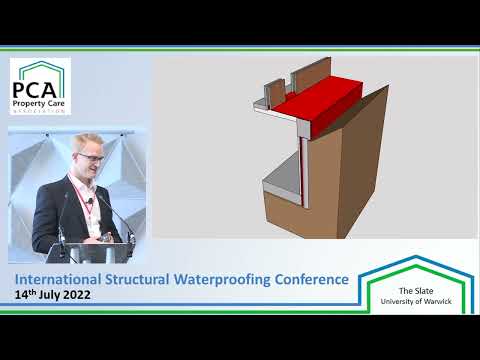
This is the failure mode that turns a podium leak into a basement leak, and it is the one most often missed. A podium deck rarely exists in isolation: at its perimeter it meets retaining walls, upstands and - where the podium sits over a basement box - the capping beam at the head of the basement structure. The podium waterproofing and the basement waterproofing are two systems that must become one continuous envelope at that junction. If the deck membrane is not lapped, bonded and detailed into the basement waterproofing at the capping-beam interface, water that lands on the deck has a direct path into the structure below. It will travel along the slab, down the wall, and surface as a weep on a soffit metres from where it entered - which is exactly why the visible damp is the end of the leak path, not its source. Continuity at this interface is the single most important detail on the whole deck, and it has to be designed by someone who owns both sides of it.
Inadequate falls and ponding
Water that cannot drain will find a way through. The most common drainage failures are insufficient or reversed falls, blocked or undersized outlets, no secondary drainage path, and no drainage void between the waterproofing and the finishes. Falls should be designed generously - typically to 1:40 so that a 1:80 minimum is reliably achieved on site once construction tolerance is taken into account, in line with BS 6229. Even 100mm of standing water creates significant hydrostatic pressure - the physical force water exerts as it builds up - pushing through the smallest defect in a membrane or joint.
Drainage, voids and the secondary path
A robust deck does not rely on the primary membrane alone. A drainage void or layer between the waterproofing and the finishes gives water a managed route to the outlets and relieves the membrane of standing load. Outlets should be recessed into the slab so the lowest point actually drains, sized for UK design rainfall (commonly assumed at 75mm/hour), and provided with a secondary path so a single blockage is not a single point of failure.
Movement joints
Concrete shrinks as it cures and slabs move with temperature. Movement joints are deliberate discontinuities, and a membrane detailed rigidly across one will split. Movement joints need a detail that accommodates the designed movement while maintaining waterproof continuity - and that detail has to be coordinated with the structural engineer’s movement strategy, not invented in isolation by the installer.
Upstands and penetrations
Services penetrations - pipes, drainage points, cables - and upstands at thresholds and planters are the classic weak points. Water rarely leaks through the membrane; it leaks where the membrane meets something else. Common defects include outlets not recessed into the slab, waterproofing dressed poorly into drainage collars, upstands taken to inadequate height, and penetrations clustered so tightly they cannot be detailed properly.
Planters and landscaping
Planted areas hold water against the deck permanently and introduce roots, irrigation and saturated build-up. Without a root barrier, a reliable drainage layer beneath the growing medium, and carefully detailed upstands around the planter, a planter becomes a reservoir sitting on the waterproofing. Green and blue roofs amplify every other failure mode because the defect is buried under saturated build-up and invisible until the damage is done.
Membrane damage during and after installation
Heavy foot traffic before finishes are installed, sharp aggregate puncturing the membrane, the absence of a protection layer during construction, and damage by following trades are all common causes. A membrane that passed its test can still be compromised by the next trade on the deck if sequencing and protection are not controlled.
Design Best Practice for Reliable Podium Decks
Independent design review at RIBA Stage 2/3
The cheapest risk mitigation on a podium is an independent waterproofing design review while the scheme is still on paper - at RIBA Stage 2 or 3, before falls, structural zones and interfaces are frozen. By the time the deck is buildable, the decisions that determine whether it leaks have already been taken. An independent specialist, with no system to sell, reviews the falls strategy, the deck-to-wall and capping-beam continuity, the drainage design and the movement strategy while they can still be changed cheaply.
Fully bonded systems
The membrane should be fully bonded to the substrate. An unbonded membrane lets water track laterally beneath it, so a single breach floods the whole deck rather than staying local; it also cannot achieve reliable continuity at details and is vulnerable to wind uplift before it is loaded. Full bonding keeps any breach contained and makes the detailing honest.
Combined (dual) protection where the consequence is high
Where the consequence of failure is high - and over an occupied basement it always is - a single line of defence is not enough. Combined protection (sometimes called dual protection) layers a primary bonded membrane with a secondary system so that the failure of one does not mean the failure of the deck. BS 8102:2022 frames this in terms of the consequence of water ingress: the higher the consequence, the stronger the case for more than one form of protection working together. On a podium over lettable space, dual protection is the default position for a careful designer, not a luxury.
Falls designed for the real world
Design falls to 1:40 to achieve the 1:80 minimum after construction tolerance. A fall that is exactly minimum on the drawing is a fall that ponds on site. Build the falls into the structural slab or a screed above it, give every low point a recessed outlet, and provide a secondary drainage path.
Simplicity and robustness
Use proven detail types, minimise penetrations and junctions, design for tolerance, and avoid details that depend on perfect craftsmanship. The best podium detail is one that still works when it is built slightly imperfectly - because it will be.
Flood (holiday) testing and on-site QA
Many podium failures are not design flaws; they are construction defects that go undetected and then disappear under finishes. Once covered, defects are invisible until water damage appears, by which point remediation is catastrophically expensive. Two forms of integrity testing matter: flood testing (water ponded to 100–150mm for 24–48 hours to prove the system holds) and holiday detection (electronic testing to find pinholes and discontinuities the eye cannot see). Pair testing with real quality assurance: confirm substrate suitability, benchmark critical details before full installation, inspect preparation, application and detailing, and record everything photographically with as-built information. A flood test costs a few thousand pounds; a failed podium deck routinely costs £100,000 or more to put right.
Who Should Design Podium Deck Waterproofing - and When
Podium deck waterproofing should be designed by an independent waterproofing specialist appointed as part of the design team, working alongside the architect and structural engineer rather than instead of them - and appointed early. The reason is the continuity problem above: the podium waterproofing and the basement waterproofing have to be designed as one envelope, and only a specialist who owns both sides of the capping-beam interface will detail it as one. Leaving the deck to be “designed” by the installing contractor, or absorbed into the structural engineer’s scope, is how the interface falls through the gap between disciplines and nobody ends up owning the one detail that matters most.
The right time is RIBA Stage 2 to 3. The earlier the specialist is appointed, the more of the falls, drainage and interface decisions are still open. By Stage 4, the framing shifts from prevention to triage.
A Real-World Failure: When Nobody Owns the Interface
The pattern is consistent in dispute work. A central London scheme with a podium over an occupied basement reaches practical completion with a few damp patches and the odd weep below the deck - niggles the contractor promises to “keep an eye on.” The niggles do not resolve; they spread into the spaces tenants need dry to fit out. Handover stalls, rent that should be flowing is not, and when the project manager goes looking for who is responsible, they find a circle: the contractor says it is fine, the architect says it is not their design, and nobody appointed to own the deck-to-basement interface was ever in the room.
We have written that case up in full, because it is the clearest illustration of why the interface, the independence and the early appointment all matter at once:
A Leaking Podium in Central London, Post-PC: What Went Wrong and What Would Have Prevented It →
Drainage Design and Hydrostatic Pressure Management
Just 100mm of standing water creates hydrostatic pressure of approximately 1 kPa. For a 100m² deck, that is 100 kN of additional load. More critically, hydrostatic pressure drives water through even tiny defects. Primary drainage requires falls built into the structural slab or achieved through a screed build-up above the structure, with UK design typically assuming 75mm/hour rainfall. Secondary drainage provides a 50–100mm void containing granular or cellular drainage layers. Additional protection measures may include root barriers for planted roofs and cavity tray systems where the deck meets below-grade structures.
Maintenance Access and Lifecycle Considerations
A podium deck is not a maintenance-free asset. It requires periodic inspection and maintenance over its 25–40 year design life. Design should provide safe access to the waterproofed surface, viewing windows or inspection ports, clear drainage routes that can be checked, and a design-life plan specifying inspection schedules. Common maintenance issues include debris blocking drainage, membrane degradation from UV and thermal cycling, coating wear requiring renewal every 10–15 years, and sealant failure as joints age. Budget and schedule maintenance as part of the original design cost.
Frequently Asked Questions
Why do podium decks leak?
Podium decks leak overwhelmingly at junctions, not in the open field of the membrane: at the deck-to-wall and capping-beam interface with the basement waterproofing, at movement joints, at upstands and penetrations, and wherever falls are inadequate and water ponds. The deepest cause is usually that the podium waterproofing and the basement waterproofing were designed as two separate systems instead of one continuous envelope, so water that lands on the deck finds a path into the structure below.
Who should design podium deck waterproofing?
An independent waterproofing specialist, appointed as part of the design team and working alongside the architect and structural engineer. Because the deck and the basement must be waterproofed as one envelope, the designer needs to own both sides of the interface - which the installing contractor and the structural engineer typically do not. Appoint the specialist at RIBA Stage 2 to 3, while the falls, drainage and interfaces can still be changed cheaply.
What falls does a podium deck need?
Design to 1:40 so that a 1:80 minimum is reliably achieved once construction tolerance is taken into account, in line with BS 6229. A fall set at exactly minimum on the drawing will pond on site. Every low point needs a recessed outlet that actually drains, sized for UK design rainfall, with a secondary drainage path so a single blockage is not a single point of failure.
Does a podium deck need dual protection?
Where the consequence of failure is high - and over an occupied basement it always is - yes. Combined (dual) protection layers a primary bonded membrane with a secondary system so that the failure of one does not fail the deck. BS 8102:2022 ties the strength of protection to the consequence of ingress, so on a podium over lettable space, dual protection is the careful designer’s default.
How CLW Approaches Podium Deck Waterproofing
At CLW, podium deck waterproofing is treated as a specialist discipline. We provide independent assessment and design not bound to any manufacturer’s system, rigorous detail development for every penetration, joint, upstand and - critically - the deck-to-wall and capping-beam interface with the basement, specification for quality assurance including flood testing and holiday detection, site presence at critical construction stages, and handover documentation with tailored maintenance plans.
Appointing an independent structural waterproofing consultant at the design stage is the most cost-effective risk mitigation available. The cost of specialist involvement is recouped many times over through avoided failures and remedial costs.
Authoritative Further Reading
For readers who want the underlying detail, these are the primary sources behind this guide:
- Ben Hickman, “Design features and best practice in podium deck waterproofing” - peer-reviewed paper, Journal of Building Survey, Appraisal & Valuation, indexed on Henry Stewart Talks. Read the paper on HS Talks →
- Waterproofing Wisdom (CLW) - the series where we work through basement and podium waterproofing on real schemes:
 Watch on YouTube ↗
Related Articles
- A Leaking Podium in Central London, Post-PC
- The Architects’ Waterproofing Trap: Why Taking Design Responsibility Is a Career Risk
- What Grade of Waterproofing Do I Need?
- Independent Waterproofing Consultants - the Buyer’s Checklist
- Construction Monitoring Services
Need Specialist Podium Deck Waterproofing Design?
We provide independent assessment, design, and construction monitoring for podium decks across the UK. Or put our specialist AI to work first: the Waterproofing Wisdom Agent reasons in BS 8102:2022 and will sense-check your deck build-up or a contractor’s proposal in minutes.
Frequently asked questions
What is a podium deck?
A podium deck is an exposed or semi-exposed structural slab that sits above occupied or sensitive space, typically a basement, car park or plant area, and carries landscaping, paving, terraces or even buildings on top. Because it must be a waterproof barrier, a structural floor and a trafficked surface at the same time, it is one of the highest-risk waterproofing applications in UK construction.
Why do podium decks leak so often?
Rarely through the open field of the membrane. Podium failures concentrate at interfaces: the deck-to-wall and capping-beam junctions, inadequate falls and ponding, blocked or missing secondary drainage, movement joints, and upstands or penetrations detailed after the membrane was designed.
What is the most serious podium deck failure mode?
Loss of continuity at the deck-to-wall or capping-beam interface. It is the failure that turns a podium leak into a basement leak, and it is the detail most often left unowned between the deck designer and the basement designer.
How should a podium deck drain?
Design falls to 1:40 so that a 1:80 minimum is achieved on site after construction tolerance, in line with BS 6229. Give every low point a recessed outlet sized for UK design rainfall (commonly 75mm/hour), provide a drainage void or layer between the membrane and the finishes, and include a secondary drainage path so that one blocked outlet is not a single point of failure.
How should a podium deck be procured to avoid failure?
With one designer owning waterproofing continuity across deck and basement, falls and drainage designed rather than assumed, a buildable sequence for the landscape build-up, and inspection and testing of the membrane before it is buried.
Related guidance
- 'We've Got the Contractor's Guarantee' - What It Covers, and When the Belief Costs Developers Millions
A genuine contractor's guarantee is worth having: it covers workmanship and, where the contractor designed the system, usually some design l
- Why the Defect Liability Period Expiring Is When Your Real Waterproofing Risk Begins, Not Ends
The defect liability period is a contractual convenience, not a description of how water behaves. On a major commercial basement it may run
- The Eurocode 2-3 Problem: Why Designing Watertight Concrete Strictly to Tightness Class Can Make It Less Waterproof
EN 1992-3 tightness classes drive crack widths down, reinforcement up and concrete quality down - while the waterproofing admixture's certif
Working on a live scheme?
Put our AI agent to work. It'll reason through your specifics from BS 8102:2022 and land on a defensible recommendation.